
Last updated November 18, 2026
 Wrought iron
 Wood & steel frame
 Farm & ranch
 Sliding driveway gates
 LiftMaster operators
Free on-site gate assessment - hinges, posts, and your LiftMaster or Nice gate operator checked before anything is quoted
The assessment is free and the quote is the invoice.
Get your free estimateDIY vs Professional Gate Repair: The Whitney Homeowner’s Decision Guide
You can replace a gate wheel yourself in 20 minutes. You should not replace a control board yourself – not because it’s hard, but because the configuration it leaves behind is invisible to every future technician without a written record. That’s the whole DIY-versus-professional question in two sentences. It isn’t about your skill level or whether you’re “handy enough.” It’s about what a repair leaves behind on the property. This guide draws the line by task type, not by confidence, and it’s written for Whitney homeowners who want the price and the reasoning visible before they pick up a phone.
Quick Answer
In Whitney, DIY is fine for mechanical and cosmetic tasks – lubrication, sensor alignment you can see, remote batteries, tightening a loose hinge – and risky for anything involving a control board, wiring, operator mounting, or limit-switch calibration. Automated gate wiring carries homeowner liability in Nevada even without a permit, and an undocumented DIY repair creates a diagnostic gap that costs the next technician time and costs you money in the form of rediscovered faults. Professional diagnostic visits run far less than a misdiagnosed board replacement.
Styles & brands we work with
- Wrought iron
- Wood & steel frame
- Farm & ranch
- Sliding driveway gates
- LiftMaster operators
Table of Contents
- Which gate tasks are safe to do yourself, and which are not
- Why low-voltage gate wiring carries homeowner liability in Nevada
- The documentation gap: what future technicians have to reverse-engineer
- Cost comparison that includes error recovery, not just parts
- How Whitney heat and desert dust change the DIY math
- What to document if you do the work yourself
- Brand-specific realities: Ghost Controls, Mighty Mule, and the rest
- When a professional visit pays for itself
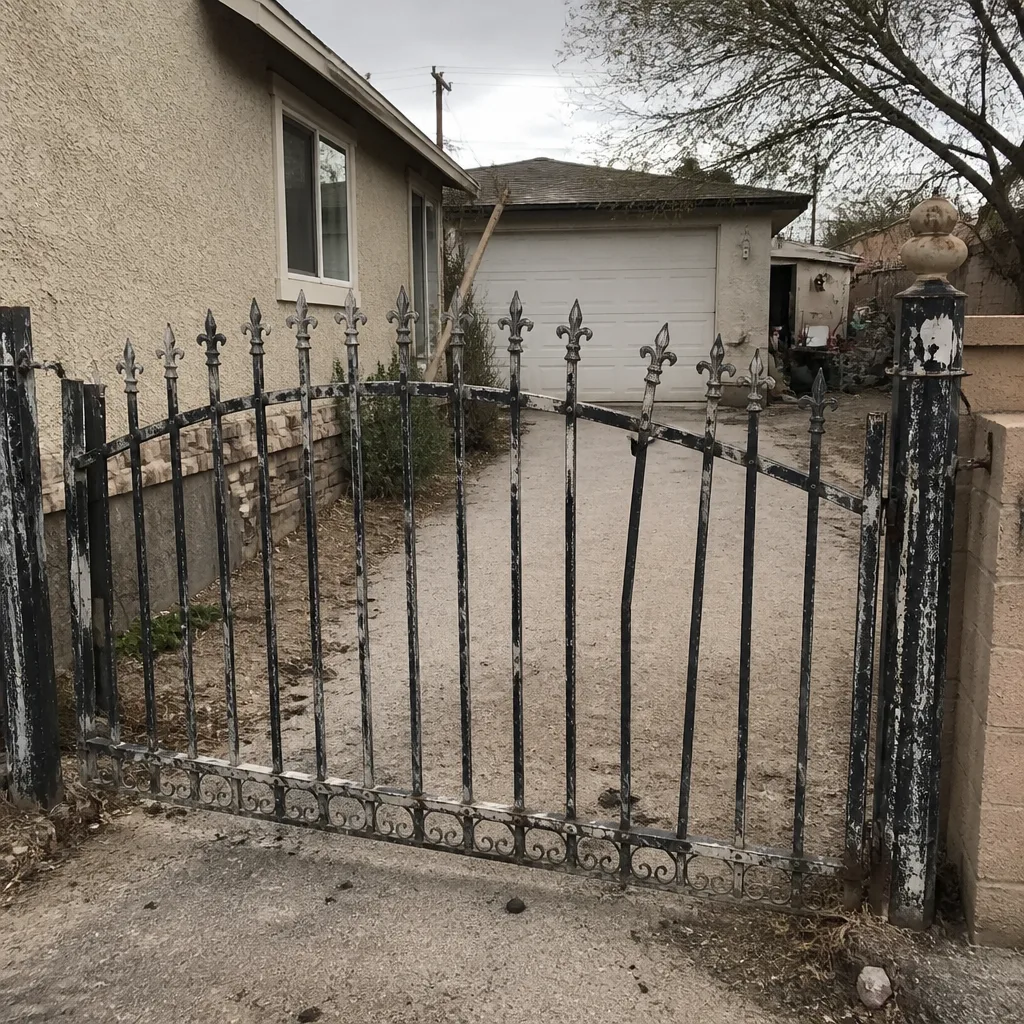 Before
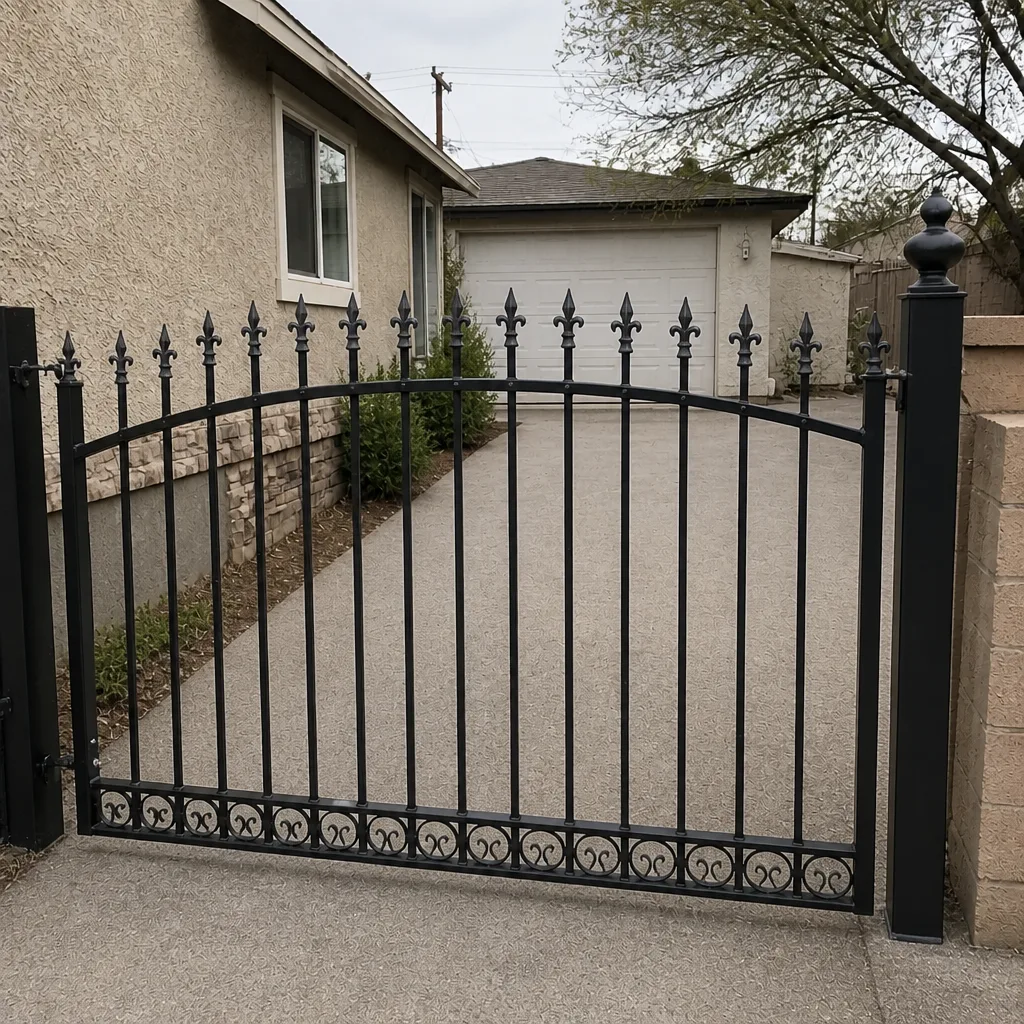 After
Which Gate Tasks Are Safe to Do Yourself, and Which Are Not
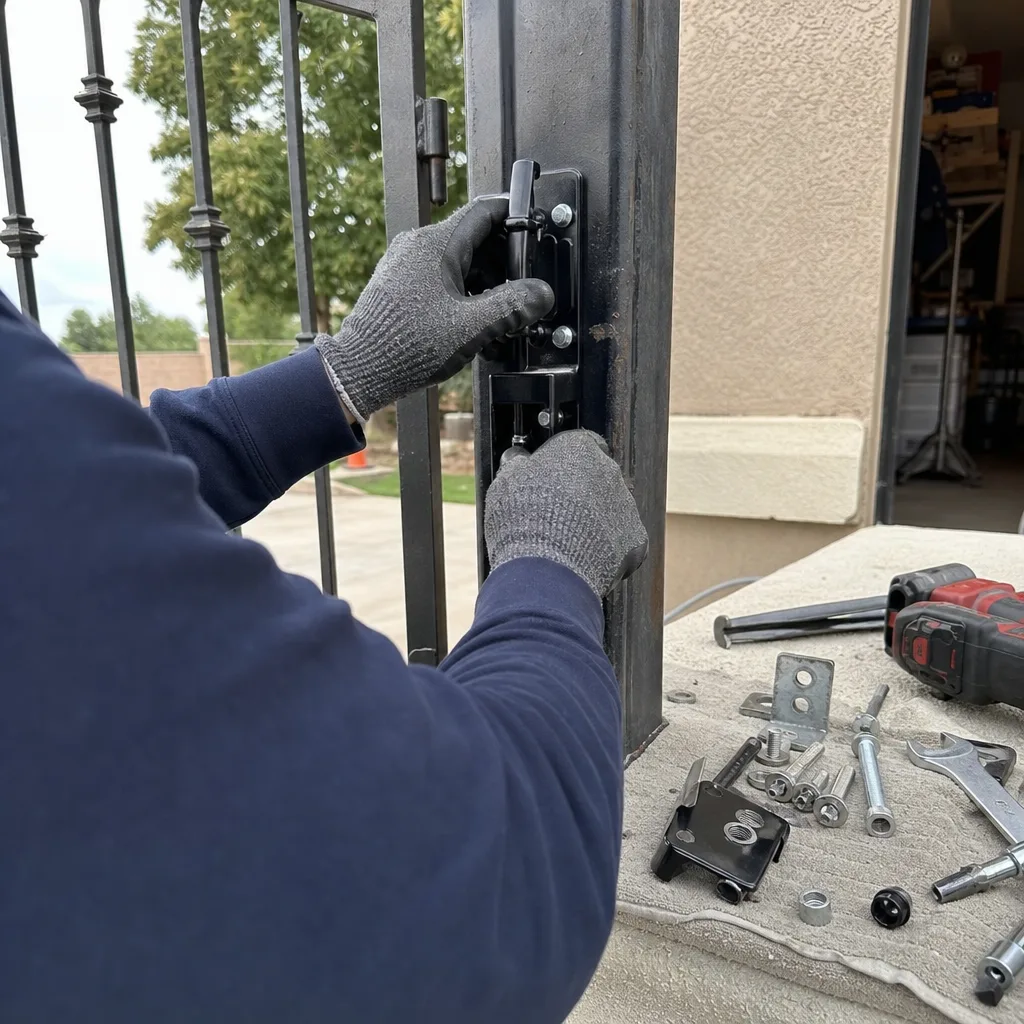
We classify every task we’re asked about by what it leaves behind, not by how hard it feels. A gate wheel that’s worn flat is a mechanical swap with no invisible consequences. A control board is a configuration artifact. The first leaves you with a working gate. The second leaves you with a working gate and a set of settings that only exist in the brain of whoever programmed them.
Here’s the split we hold to when a Whitney homeowner asks us whether to try it themselves:
-
Safe DIY (mechanical and cosmetic):
- Lubricating hinges, rollers, and the operator arm pivot with a dry or silicone-based product – not grease, which traps desert dust.
- Aligning a photo-eye (the infrared beam that stops the gate if something crosses the path) when the mounts are visibly knocked out of line and nothing is bent.
- Replacing remote-control batteries and re-pairing a remote to a receiver you already know works.
- Tightening a loose hinge bolt or a rattling latch plate.
- Clearing debris from the track of a sliding gate and washing dust off the wheels.
- Straightening a slightly bent sign plate or reattaching a kick plate with the same fasteners.
-
Professional-only (configuration and life safety):
- Control board replacement and programming.
- Any change to low-voltage wiring, loop detectors, or the power run.
- Operator mounting and re-mounting when the arm bracket is bent or the post has shifted.
- Limit-switch calibration (setting where the gate stops in each direction).
- Safety-edge and photo-eye repair on equipment that fails its obstruction test.
- Spring and counterweight work on any gate with stored mechanical energy.
If you’re not sure which side a task falls on, call before you touch it. A live person answers at Vance Gate Repair Whitney around the clock, and we can tell you in a two-minute conversation whether it’s a Saturday project or a dispatch.
Why Low-Voltage Gate Wiring Carries Homeowner Liability in Nevada Even Without a Permit
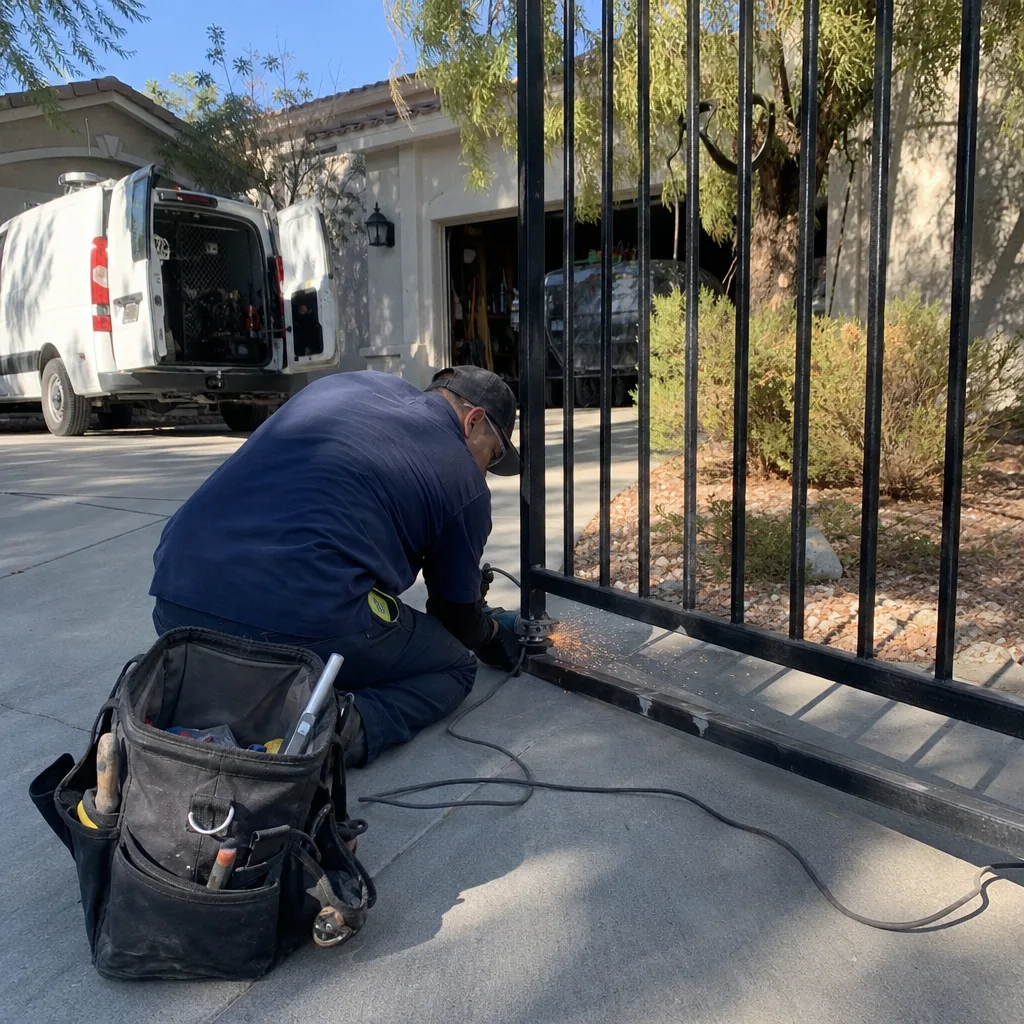
People hear “low voltage” and assume the risk is low. That’s a category error. Low voltage is a shock hazard concern, yes, but the real exposure on an automated gate is what happens when a moving barrier fails to reverse on contact or on interruption of the photo-eye. That’s a life-safety function, and in Nevada a homeowner who modifies that wiring – even if no permit is pulled – owns the outcome.
What that means in practice:
- If a child or pet is injured because a safety edge was bypassed or a photo-eye was moved without recalibration, the question becomes who modified the equipment. If you did, that’s you.
- Homeowner’s insurance carriers increasingly ask whether an automated gate was serviced by a qualified technician. A DIY wiring modification can become a coverage issue at the worst possible moment.
- A property sale can stall if a buyer’s inspector flags undocumented electrical work on a gate operator. A written record from a licensed company resolves it; a hand-drawn diagram in your head does not.
- Limits set past travel can over-torque an operator arm and crack the housing – a $40 fix becomes a $400 one.
We’re not saying the wiring is complicated for someone who knows what they’re doing. We’re saying the liability attaches to the modification regardless of who made it, and a written record from a company that services the equipment transfers that risk to someone who can be asked to stand behind it. That’s what we do at Gate Repair in Whitney every day.
The Documentation Gap: What Future Technicians Have to Reverse-Engineer
This is the part almost nobody talks about when they compare DIY to professional. A repair isn’t just a fix – it’s a piece of information left on the property. When a technician who has never seen your gate arrives to diagnose a new problem, they’re reading a story written by whoever worked on it last. If that story is missing pages, everyone downstream pays for it.
Here’s what we routinely have to reverse-engineer when a gate has a history of undocumented DIY work:
- Whether the operator was swapped for a different model (the label is gone, the mounting pattern is the tell).
- What the limit-switch positions were before someone moved them – we usually find this by feel, not by reading.
- Whether the photo-eye wiring was rerouted, spliced, or extended with a different gauge.
- Whether the loop detector is still connected to the same input the operator expects.
- What brand and part number the control board actually is – because the sticker has been wiped clean by desert dust and heat.
- Whether the safety edge was tested after the last repair – often it wasn’t, and now it fails silently.
Each of those items can burn 20 to 40 minutes of diagnostic time before we touch a tool. On a paid service call, that’s $60 to $120 of the invoice going to rediscovery, not repair. Multiply by two or three undocumented repairs over a gate’s life and you’ve paid for a documented service several times over without a single pound of work. This is why we document every visit under The Haven Standard – photos of what we found, wiring diagrams of what we set, and part numbers of what we installed, left with you and filed in the job record.
If you’re planning a new gate or a motor replacement, the same principle applies from day one – that’s what Gate Installation in Whitney is built around.
Cost Comparison That Includes Error Recovery, Not Just Parts
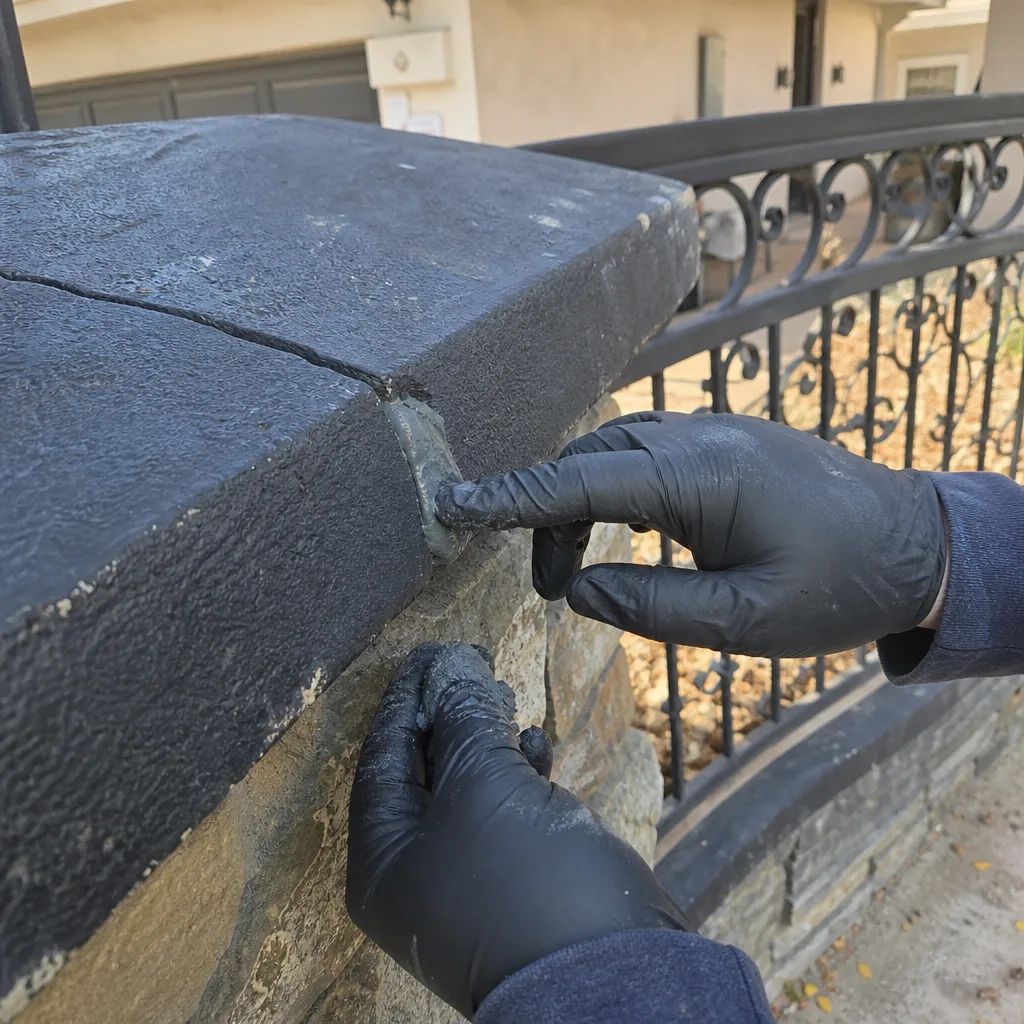
The DIY math almost always stops at the price of the part. The real comparison includes the cost of being wrong. Here’s a number set drawn from what we see repeatedly in Whitney:
- DIY control board replacement after a misdiagnosis: $180 – $340 for the board, plus the original $60 – $120 diagnostic you skipped, plus a second board if the first one was wrong, plus labor time. Realistic total: $300 – $550 and two weekends.
- Professional diagnostic visit that catches the actual fault (often a limit switch or a photo-eye): $85 – $150 for the visit, plus $30 – $90 for the correct part. Realistic total: $115 – $240, done in one visit.
- DIY limit-switch “adjustment” that overtravels the arm: $25 for a wrench, then $320 – $480 for a new operator arm and housing.
- Professional limit-switch calibration: $0 additional on a service visit, because it’s part of the diagnostic and calibration work.
- DIY gate wheel replacement: $15 – $40 for the wheel, 20 minutes, low risk.
- Professional gate wheel replacement: $80 – $140, includes inspecting the bracket and track.
Notice where DIY wins – the mechanical swap with no configuration consequence. That’s the honest pattern. Mechanical tasks: DIY often makes sense. Configuration tasks: the error recovery cost swallows the part savings every time. If you have a written estimate from another company and want a second opinion before you spend anything, we review it at no cost – just bring the paperwork. That’s the same principle we apply on every Gate Motor & Opener in Whitney job.
How Whitney Heat and Desert Dust Change the DIY Math
Whitney’s climate has specific consequences for gate maintenance that you won’t read in a national DIY guide. The combination of 100°F-plus summer afternoons and fine desert dust creates three predictable failure modes, and each one tips the DIY-versus-professional decision in a particular direction.
- Dust in the track and rollers: fine dust grinds against the wheel bearings faster than in a wetter climate. Mechanical cleaning and lubrication here is genuinely a homeowner task – do it quarterly and you’ll extend wheel life by years.
- Heat expansion in the drive arm and housing: operators that were calibrated in a mild month drift out of tolerance in August. That’s not a fault, it’s thermal expansion, and it shows up as a gate that stops short or slams. Limit-switch recalibration is a professional task – but knowing why it’s happening saves you from a panicked “the motor is dying” diagnosis.
- Dust-caked photo-eyes and safety edges: the most common cause of a gate that won’t close in Whitney is a lens that’s filmed over with dust. Wiping the lens with a microfiber cloth is safe DIY. Replacing or realigning the eye is not.
Spring and counterweight work on swing gates deserves its own line here: any gate that holds stored mechanical energy is a professional task. We don’t hand out instructions for those components, and no responsible guide should – the injury potential is real and it happens in a fraction of a second. If your gate has a spring, call us.
What to Document If You Do the Work Yourself
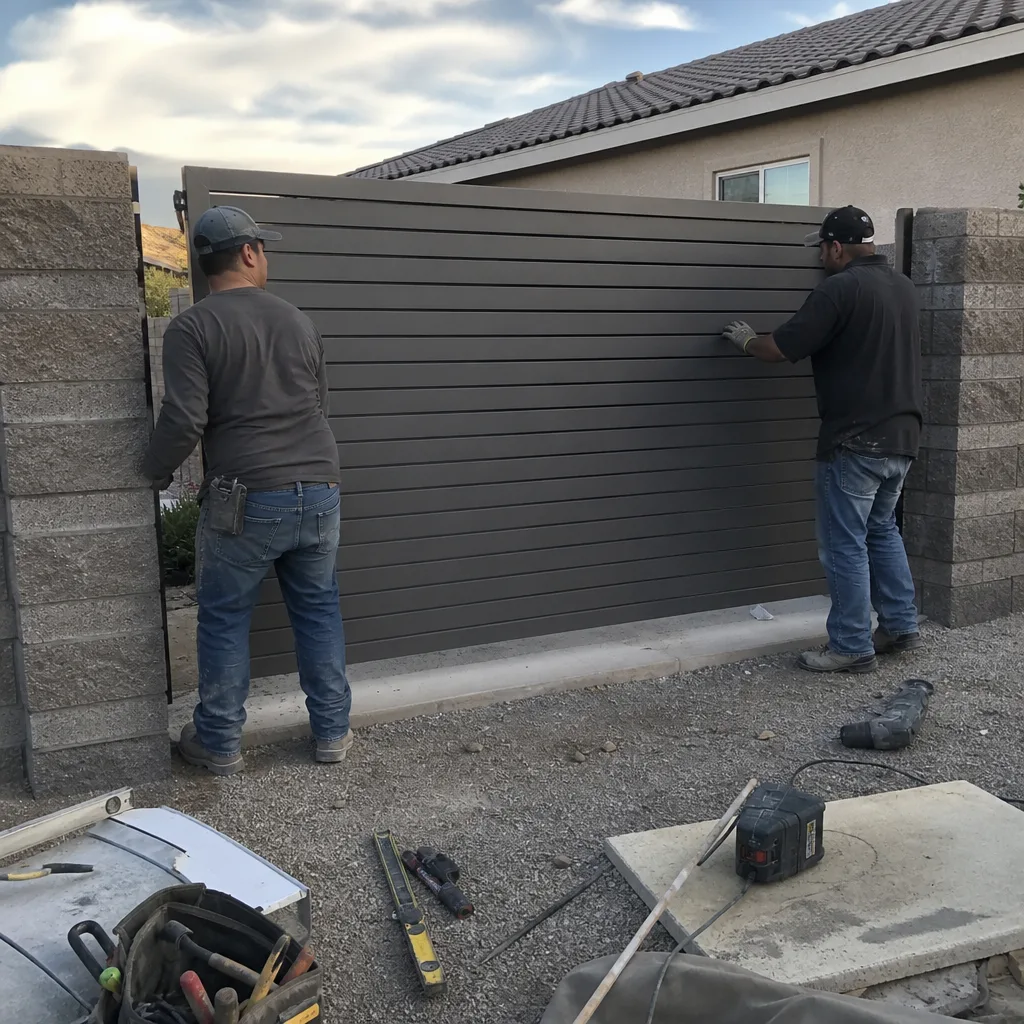
If you decide to handle a mechanical task yourself, leave a record. This is the single habit that separates a clean DIY repair from one that costs the next owner money. You’re not editing a novel – ten minutes with a phone camera and a notepad protects you at resale and saves the next technician a diagnostic hour.
- Photograph before you start. Wide shot showing the whole gate, close-up of the component you’re changing, and one shot that shows the mounting orientation.
- Photograph during the work. The part number on the old component before you discard it. The wiring color order before you disconnect anything. The position of any adjustable feature (limit switch, arm bracket, sensor mount) before you move it.
- Photograph after. Same wide shot as step 1, plus a close-up of the new part installed. Date-stamp everything.
- Write down the part number and brand. On a piece of paper, taped inside the operator housing. “Replaced gate wheel, brand X, model Y, [date].” That note is worth more than a drawer full of receipts.
- Test and record the result. Run the gate through three open-close cycles. Confirm the photo-eye stops it on interruption. Write down whether it did. If it didn’t, that’s a professional visit, not a “I’ll get to it.”
- File the record with your home documents. Not in a phone that might be replaced. In the folder you’d hand a buyer.
What you cannot document yourself is the calibration of a control board, the wiring diagram of a modified harness, or a limit-switch reading in degrees. Those belong to a technician who does it for a living, and that’s the dividing line we work to every day at Vance Gate Repair Whitney home.
Brand-Specific Realities: Ghost Controls, Mighty Mule, and the Rest
The brand on your operator changes the DIY calculus, and it’s worth naming. Ghost Controls and Mighty Mule are the two brands most often installed by homeowners in Whitney because they’re sold at retail and installed with a printed manual. That’s fine for the initial install – those companies write good documentation. The problem comes later, when the unit needs a repair and the homeowner is working from a manual written for a first install, not a fault diagnosis.
We work on nine major gate-automation brands – LiftMaster, FAAC, BFT, Linear, Viking, Ghost Controls, DoorKing, Elite, and Mighty Mule – and the pattern holds across all of them: the retail-installed units are the ones with the most undocumented modifications when they come to us. A Ghost Controls unit that was reprogrammed by a homeowner two seasons ago often has soft-start and obstruction-sensitivity settings that don’t match factory spec, and nothing in the manual tells you which setting was changed.
What we can tell you from the field: on those brands, a professional diagnostic visit is often the cheapest way to avoid a full operator replacement. A DoorKing or Elite control board that’s behaving strangely is more often a wiring or limit-switch issue than a dead board, and replacing a board on a bad diagnosis is the single most common over-payment we see on residential gates in Whitney.
When a Professional Visit Pays for Itself
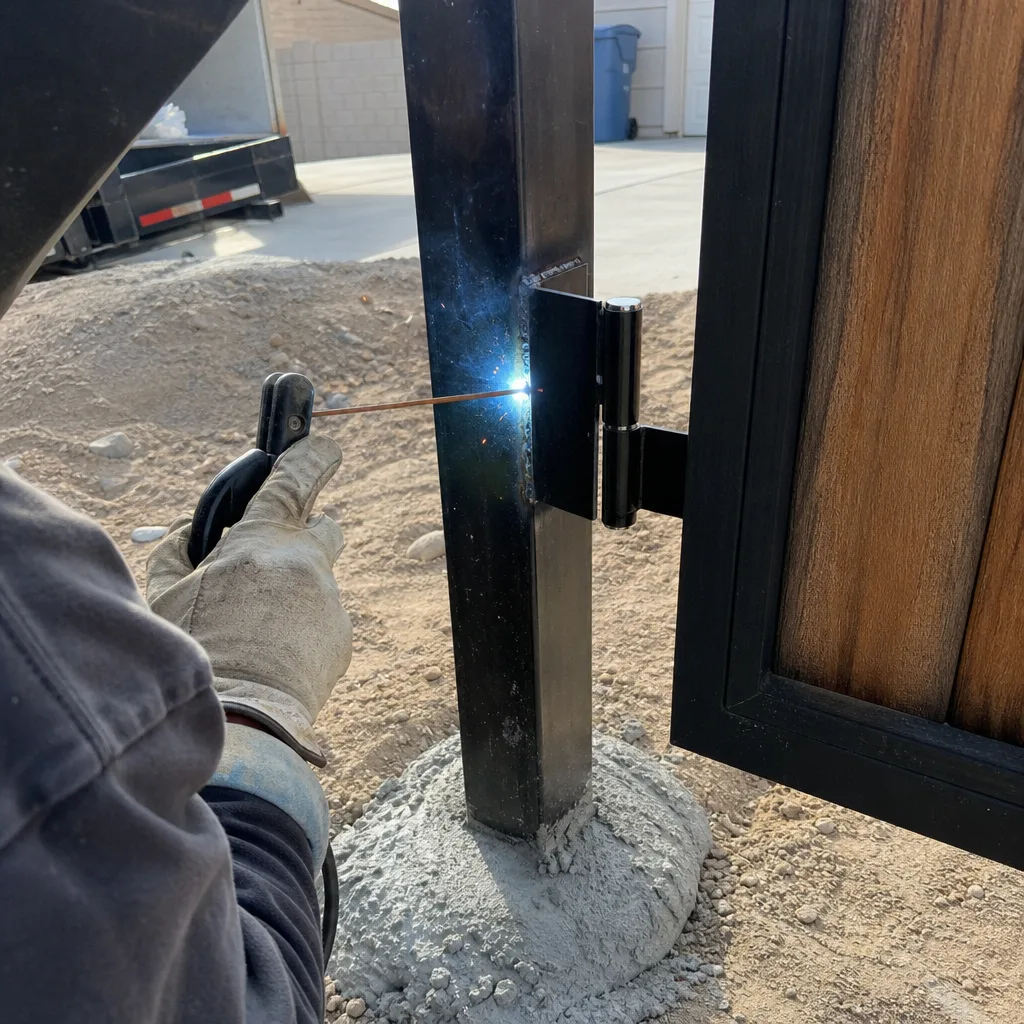
We’re not going to tell you to call for every task. Some things are genuinely yours to handle, and the honest answer is that you’ll save money and time doing them. The professional visit pays for itself when any of the following is true:
- The gate fails its obstruction test – the photo-eye should stop it, and it doesn’t.
- Any control board is suspected of being dead or has been swapped for a different model.
- The operator arm is bent, the post has shifted, or the gate is visibly out of level.
- Springs, counterweights, or any component that stores mechanical energy is involved.
- Wiring has been modified, spliced, or rerouted at any point since the last documented service.
- You’re preparing to sell and need a documented service record for the gate.
Vance Gate Repair Whitney offers free estimates and a free second opinion on any written estimate from another company. Prices are quoted and agreed in writing before any work starts, and every visit includes a documented photo record at no additional charge. Our technicians have up to 12 years of experience, and a live person answers the phone around the clock. Call (844) 797-4861 and we’ll tell you, honestly, whether your task is a Saturday project or a dispatch.
Common Mistakes to Avoid
- Replacing a control board on a guess. The most expensive mistake we see. Board failures are rarer than limit-switch or wiring faults, and the board is the most expensive part on the operator. Diagnose first, replace second.
- Setting limits by eye instead of by degrees. A limit switch set 12 degrees past travel will eventually crack the drive housing. Eyeball adjustments are how that happens.
- Use of grease on gate hinges. In Whitney’s dust, grease becomes an abrasive paste. Use dry or silicone-based lubricant and reapply quarterly.
- Bypassing a photo-eye to “test” the gate. A bypassed safety eye is an unmonitored moving barrier. If you test it, test it by interrupting the beam and confirming the gate reverses – not by disconnecting it.
- Discarding the old part before photographing the label. The part number on the old component is the single most valuable piece of information you’ll ever have about your gate.
- Assuming “low voltage” means “low risk.” The voltage is low; the life-safety function it controls is not.
- Treating a gate that works as a gate that’s safe. A gate can operate smoothly and still fail its obstruction test. Test it monthly.
See the difference
BeforeAfter Before
 After
 Before
 After
When to Call a Professional
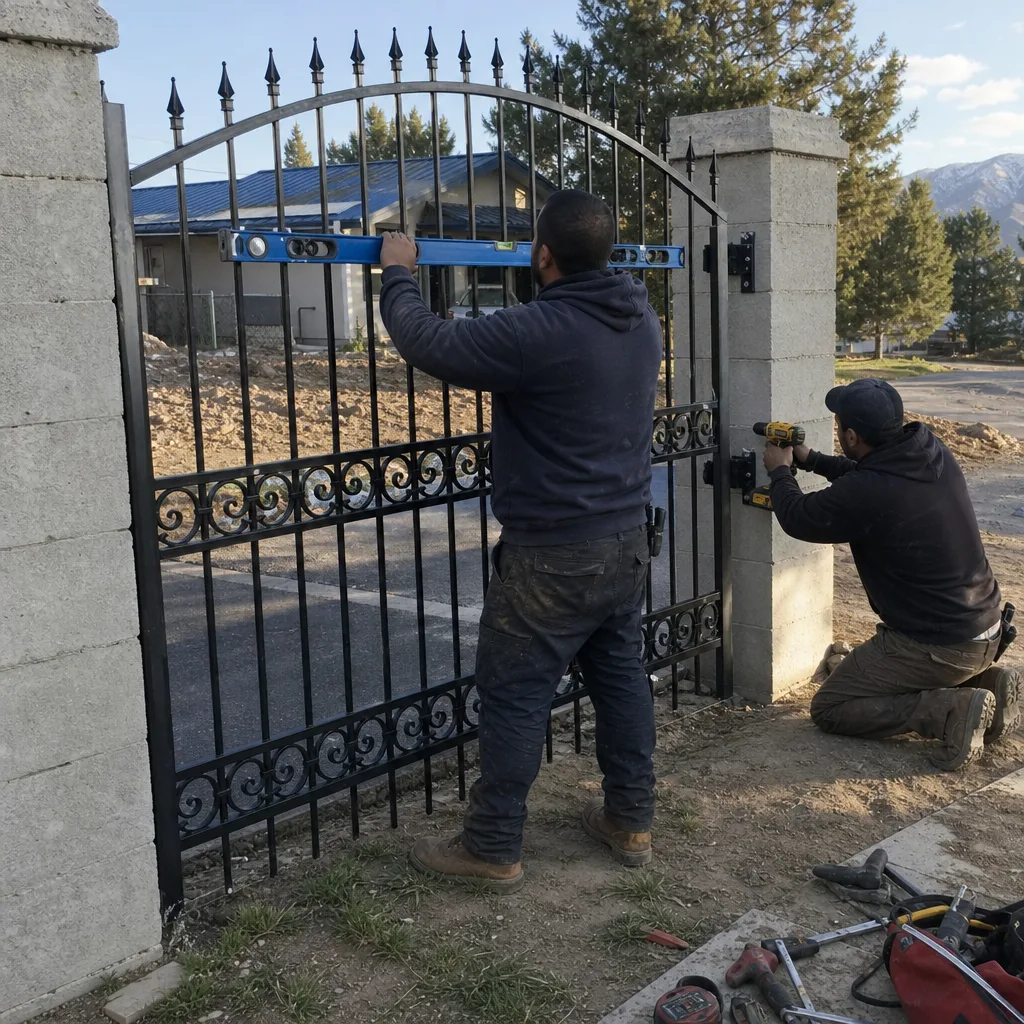
Call us when the task involves configuration, wiring, safety functions, or stored mechanical energy. If your gate fails its obstruction test, if the control board is suspect, if the operator arm is bent or the post has shifted, if any wiring has been touched since the last documented service, or if a spring or counterweight is involved – those are dispatch tasks, not weekend projects. The same applies if you’re preparing a property for sale and need a documented gate service record, or if you have a written estimate from another company and want a second opinion before you spend anything.
Vance Gate Repair Whitney offers free estimates in Whitney – call (844) 797-4861. We’ll give you a written price before any work starts, and a documented photo record when we leave.
Frequently Asked Questions
No – operator mounting and wiring are professional tasks in Whitney, both because the mounting requires level and torque precision that’s hard to achieve without experience and because the safety functions (photo-eye, safety edge, limit stops) have to be verified after install. A homeowner can usually handle the mechanical swap on a gate wheel or a hinge; the operator is a different category. Call (844) 797-4861 for a free written estimate on operator service or replacement.
Low-voltage gate wiring often doesn’t require a permit, but “no permit” doesn’t mean “no liability” – the homeowner owns the outcome of any safety-function modification, including photo-eye and safety-edge wiring. That’s the exposure most people miss. If wiring has to change, have a professional do it and leave a documented record. We can review it at no charge – call (844) 797-4861.
Diagnostic visits typically run $85 – $150 in the Whitney area, and the visit usually includes calibration and a written record of what was found. That’s often less than the cost of the first wrong part in a DIY diagnosis. Prices are quoted and agreed before any work starts. Call for an exact quote – estimates are free.
Usually not – a gate that opens but won’t close is most often a photo-eye fault, a safety-edge fault, or a limit-switch issue, and all three are professional tasks. In Whitney, the most common cause is a dust-filmed photo-eye lens, which you can safely wipe with a microfiber cloth as a first step. If wiping the lens doesn’t fix it, stop and call. Call (844) 797-4861 for same-day help in most cases.
Yes, and it’s a common call. Bring whatever you remember about what you changed and, if you have it, a photo of the part you removed. We’ll document what’s there now so the next technician doesn’t have to reverse-engineer it. The sooner we document it, the cheaper the next repair. Call (844) 797-4861 and we’ll set up a documentation visit.
A written service record from a licensed company is what carries weight in a warranty claim or a property sale – a homeowner’s own notes, no matter how good, don’t carry the same authority. That’s why every Vance visit leaves a documented photo record. If you’re preparing a property for sale in Whitney, call for a pre-sale gate inspection and documentation visit – free estimate, written scope, no surprises.
The Bottom Line
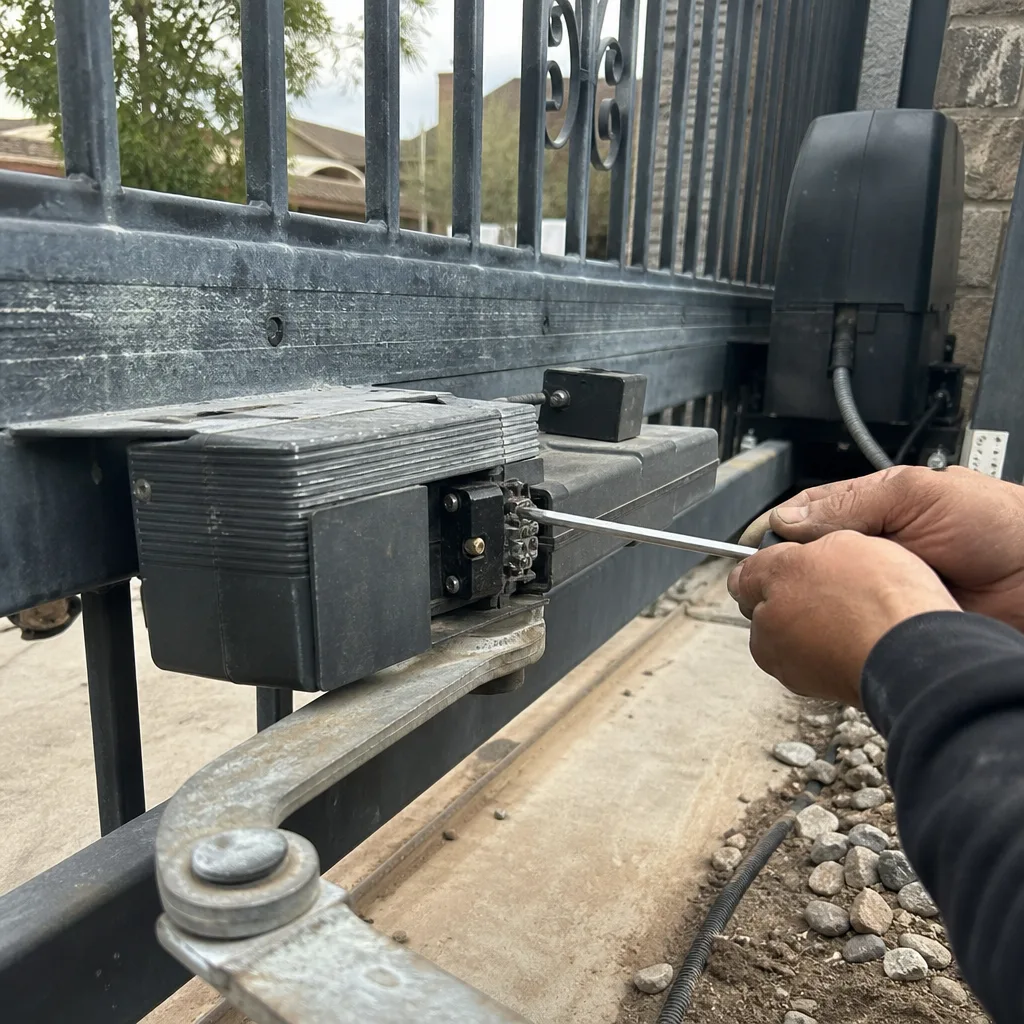
The DIY-versus-professional question isn’t about whether you’re capable. It’s about what the repair leaves behind. Mechanical and cosmetic tasks – lubrication, wheel swaps, remote batteries, dust cleaning, hinge tightening – are genuinely yours to handle, and doing them quarterly in Whitney’s dust will extend the life of your gate. Configuration tasks – control boards, wiring, limit switches, operator mounting, safety functions – carry homeowner liability and a diagnostic cost that swallows the part savings every time. Draw the line by task type, document everything you touch, and call us when you’re not sure which side you’re on. The best repair is the one that leaves a clear record for whoever comes next.
Ready for a professional opinion or a free second opinion on an existing estimate? Call Vance Gate Repair Whitney at (844) 797-4861 – a live person answers around the clock, we’ll quote in writing before any work starts, and we’ll leave a documented photo record when we’re done.
Written by the team at Vance Gate Repair Whitney.