
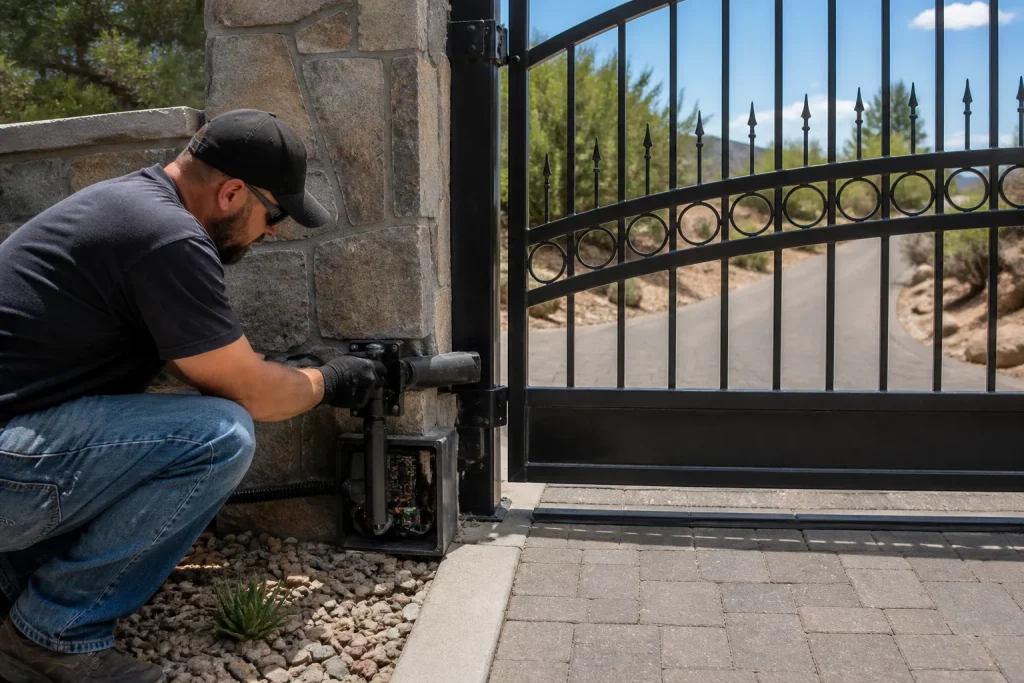
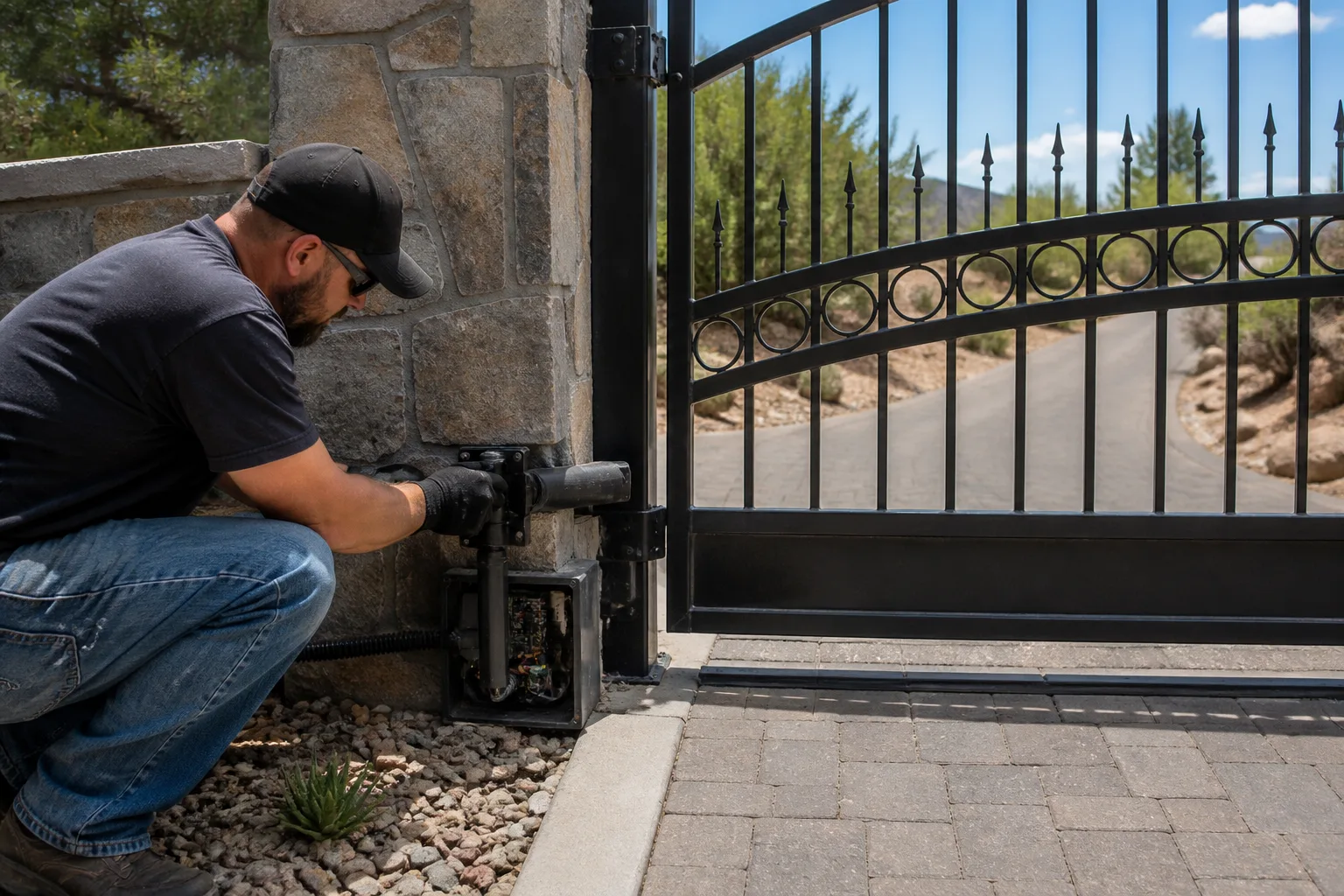
Viking Gate Repair in Whitney: A Homeowner’s Guide
Viking’s own service manual lists seven distinct fault codes that all produce the same symptom: a gate that won’t open. Most technicians check one, guess, and start swapping parts. Viking operators are built for commercial traffic, and they fail on residential gates in ways that light-duty logic doesn’t predict. Here’s what actually goes wrong, what a real diagnostic looks like, and what should be written down before anyone touches your gate in Whitney.
If you’d rather not sort through fault codes on a Saturday morning, call (844) 797-4861. We’ll talk it through.
Key Takeaways
- Viking operators are commercial-grade machines, so the diagnostic sequence differs from what works on a LiftMaster or Linear residential unit.
- In Whitney’s heat and dust, the limit switch, torque arm, and photo-eye alignment wear before almost anything else.
- A written scope should include limit-switch readings, torque-arm settings, and obstruction-force test results, not just “repaired gate.”
- Ask any technician to show you the Viking manual they used. A brand this particular doesn’t tolerate generic habits.
How is Viking different from a typical residential gate brand?
Viking builds for continuous commercial cycles: parking lots, apartment entries, industrial yards. Residential brands like Linear or LiftMaster are engineered around a few open-close cycles a day. That difference shows up in the wiring architecture. Viking control boards often run separate terminal blocks for loop detectors, access-control inputs, and safety edges, with heavier gauge conductors and a board layout that assumes an installer who reads schematics. It’s the reason a technician trained on residential openers can look at a Viking board and freeze.
Why does that matter for diagnosis? Because the sequence changes. On a residential unit, you might start by checking the obvious: battery, remote, safety reverse. On a Viking, you start with the fault-code table and the physical inputs feeding the board. The loop detector (the buried wire that tells the operator a car is waiting) and the safety edges each report separately. If one input is open, the gate can read exactly like a dead motor.
In our experience servicing Viking operators across Whitney, a fair share of “dead motor” calls turn out to be a misread input on the board. That’s a $0 part and 20 minutes of testing if the technician followed the manual. It’s a motor replacement if they didn’t.
Why do Viking gates fail differently in Whitney than at the coast?
Whitney’s dust and dry heat hit gate hardware in a specific order. Coastal installs deal with salt corrosion; Whitney installs deal with grit. Fine dust works into the limit-switch housing and the torque-arm linkage and turns into an abrasive paste. Over a summer, that changes the feel of the gate arm and throws off the travel limits. We pulled a Viking arm out of a garage near the Whitney Ranch area recently where the limit cam had drifted about 10 degrees from where it was set at installation. The homeowner had been resetting the gate by hand for a month.
Heat does the rest. Viking control boards and motors are rated for high ambient temperatures, but a metal gate sitting in full afternoon sun can push the enclosure past what any operator expects. The components that wear first in Whitney, in our experience:
- Limit switches and cams – dust intrusion and heat drift both throw off travel settings.
- Torque-arm and linkage bushings – dry out and develop play faster than at the coast.
- Photo-eyes – dust film scatters the infrared beam; a 2-inch misalignment is common after a windy stretch.
- Loop detector wiring – heat cycling at the pavement seam loosens the splice.
None of those are motor failures. All of them present as one.
What should a written scope for a Viking repair include?
A verbal estimate tells you a price and a promise. A written scope tells you what was measured. For a Viking operator, that’s a short but specific list. Ask for it before work starts, and if a company won’t put it in writing, that’s your answer.
- Fault codes read and cleared – the specific code numbers, not “checked codes.”
- Limit-switch readings before and after adjustment – the actual degree or position values.
- Torque-arm setting and linkage condition – the setting it was on, the setting it’s on now.
- Obstruction-force test results – Viking publishes force ratings; the test result should be recorded against them.
- Loop detector baseline readings – frequency and sensitivity at the board, so the next tech has a reference point.
- Photo-eye alignment confirmed – photographed, not just noted.
- Part numbers for anything replaced – model and part number, so you can price a replacement later.
Under the Haven Standard, every Vance visit comes with a photo record of what we found, what we set, and what we installed, left with you and filed in the job record. That’s the standard to hold any company to on a Viking gate, because Viking components don’t forgive guesswork. A technician who resets a limit switch without recording the new position has just handed the next problem to whoever shows up next.
How do you know a technician actually read the Viking manual?
Ask them one question before they start: “What’s the obstruction-force rating on this operator, and what did you measure on the test?” A technician who knows Viking will answer from memory or pull the manual. A technician applying generic gate habits will change the subject.
Viking publishes its specs on the operator itself and in the manual, and the force rating is one of them. It’s not a trick question. It’s the same test an access-control tech would run on a commercial site before signing off. On a commercial install, the documentation is the deliverable. A residential Viking gate deserves the same treatment, because the equipment is the same equipment.
A few other tells we’ve watched for:
- They ask for the model number before quoting a price.
- They test the loop detector and safety edges before touching the motor.
- They photograph the board before and after, not just the finished gate.
- They give you the fault code in writing.
- They don’t reach for a motor replacement on a 30-minute limit-switch job.
The last one matters most. Viking repairs and Viking replacements are different conversations, and you should never be steered to the expensive one before the diagnostic is finished. We service nine major automation brands, including LiftMaster, FAAC, BFT, and Viking, and the answer is almost always repair first when the board and motor are healthy.
When should you call a pro instead of troubleshooting?
If the gate is a swing gate with a Viking arm, and the arm has drifted or the limit switch is out of adjustment, that’s a call. The torque-arm is under real tension and a mistimed hand adjustment can damage the linkage or, worse, the operator. High-tension gate arms and springs are a genuine hazard, and no homeowner should be loosening linkage bolts to chase a fault code.
Call a technician if any of these are true:
- The gate moves partway and stops, or reverses without warning.
- A fault code has appeared and won’t clear.
- The gate won’t respond to any input (remote, keypad, loop).
- You’ve already tried a battery or power-cycle reset with no change.
- You smell burning at the control board enclosure.
For a broader view of what we handle across the area, see our Gate Repair in Whitney page. If the operator itself is the question, Gate Motor & Opener in Whitney covers the brands and what a motor replacement involves. New builds and replacements live here: Gate Installation in Whitney. And the full Vance Gate Repair Whitney home page has the company-level details if you’re comparing companies.
The Bottom Line
Viking operators reward the technician who reads the manual and punish the one who doesn’t. In Whitney, expect limit-switch drift, torque-arm wear, and dust-driven photo-eye misalignment before any motor failure, and insist on a written scope that names the fault code, the readings, and the part numbers before anyone picks up a wrench. The 365-Day Done Right Promise covers every repair we complete, and that’s possible because we write down what we found before we touch it.
If you’re in Whitney and need help, Vance Gate Repair Whitney offers free estimates. Call (844) 797-4861. A live person answers, any hour.
Frequently Asked Questions
Most Viking repairs in Whitney run between $185 and $450 depending on the fault. Limit-switch adjustments and photo-eye realignment sit at the low end; loop detector repair or board-level work trends higher. The price is written and agreed before any work starts under the Haven Standard. Call (844) 797-4861 for an exact quote. Estimates are free.
In most cases, yes. We answer the phone around the clock, and if a Viking gate in Whitney is stuck open or stuck closed, we’ll get a technician moving. Bring the fault code if the display is showing one. Call (844) 797-4861.
Usually not. In our experience on Viking operators in Whitney, a stuck gate is more often a limit-switch fault, a misaligned photo-eye, or an open loop-detector input than a dead motor. The only way to know is to read the fault code and test the inputs. Call (844) 797-4861 and we’ll walk through what you’re seeing.
A written scope for a Viking repair should list the fault codes read, limit-switch readings before and after, torque-arm setting, obstruction-force test results, loop-detector baseline readings, photo-eye alignment, and part numbers for anything replaced. A verbal estimate covers a price and nothing else. Call (844) 797-4861 for a free written scope on your Viking gate.
Written by the team at Vance Gate Repair Whitney.
Need Gate Repair Help?
Call Vance Gate Repair Whitney - licensed & insured, here with fast after-hours help in Whitney.
(844) 797-4861