
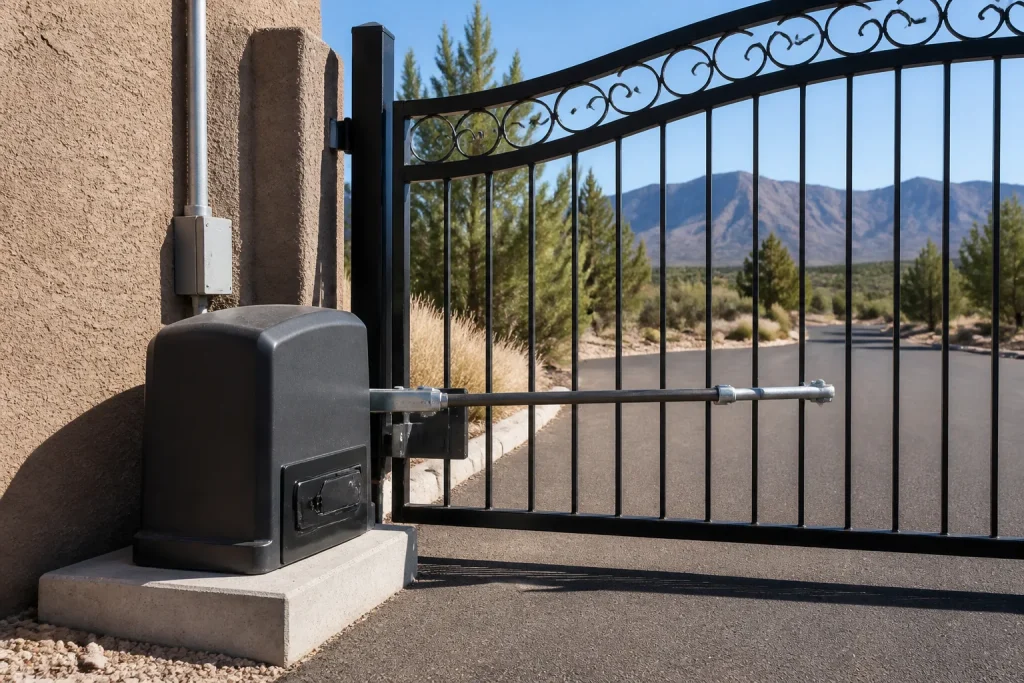
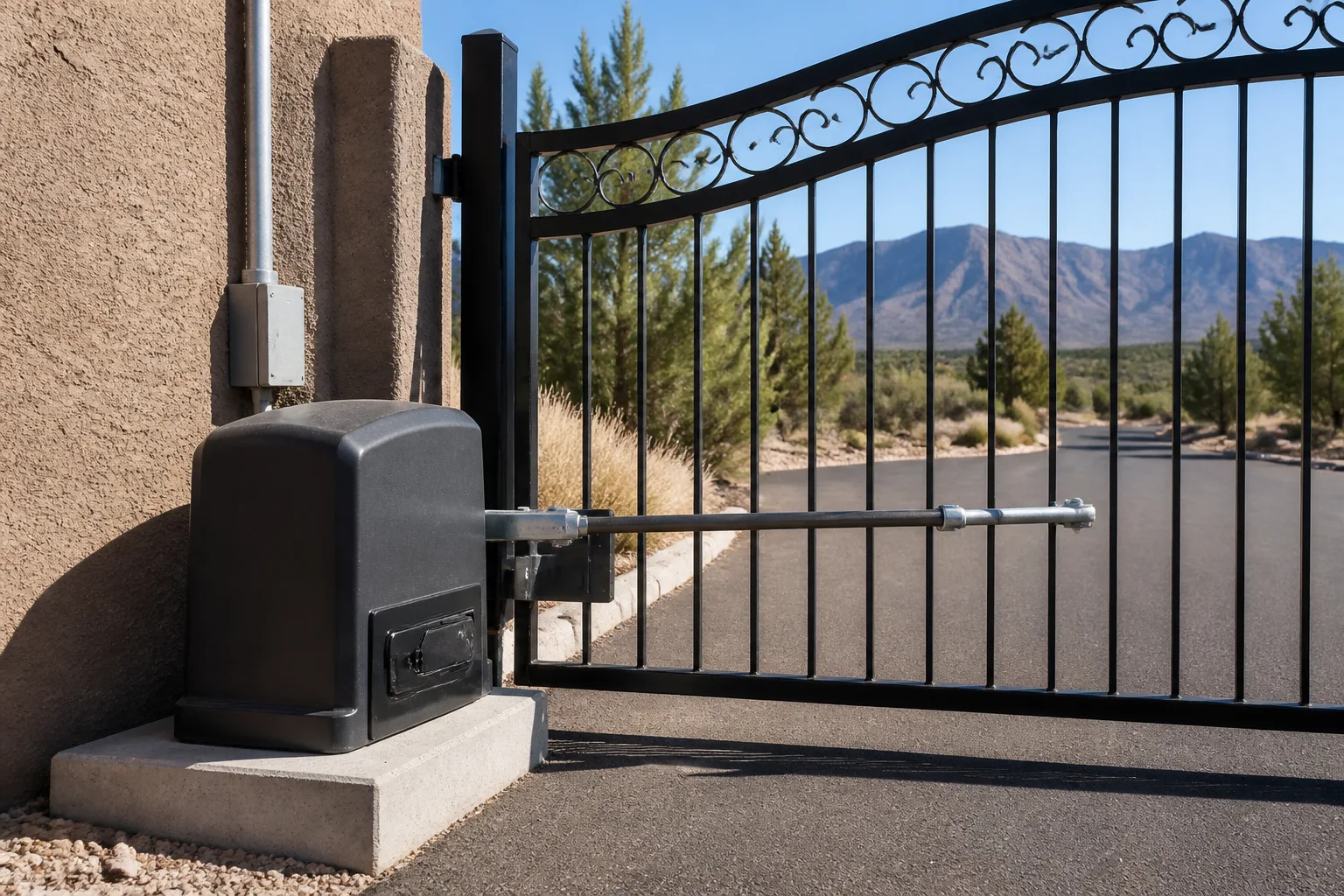
Gate Motor & Opener: Repair or Replace? How Whitney Homeowners Decide
Most gate motors that run hot and slow have one of three problems: binding hinges, limit switches set past travel, or hardware dragging on the track. Only one of those three justifies a new motor. The other two are usually fixed with under $80 in parts if the technician knows what to look for. In our experience, the replacement quote arrives far more often than the diagnostic does, and those are not the same thing. If you’d rather not climb the ladder yourself, call (844) 797-4861 and we’ll put the meter on it.
Key Takeaways
- A motor that strains is usually fighting its own gate, not failing on its own.
- The amp draw at the control board tells you whether the problem is the motor or the load.
- A written diagnostic with amp readings and limit-switch data is the only way to know a replacement is actually needed.
- Gate automation can’t be promised same-day. It’s measured, ordered and scheduled, with a written price before anything starts.
Why does a gate motor run hot and slow, and when is it not the motor?
A motor that strains is almost always fighting something. The gate itself, most often. Three mechanical load causes account for the majority of “the motor is dying” calls we diagnose in Whitney, and two of them cost almost nothing to fix.
- Binding hinges. A hinge that’s dry, rusted or slightly bent adds friction the motor has to overcome on every pass. The gate moves, so nobody suspects the hinge. The motor works harder, runs warmer, and the homeowner assumes the motor is tired.
- Misaligned limit switches. A limit switch tells the motor when to stop. Set it a few degrees past the gate’s actual travel and the motor keeps pushing against a gate that can’t go any farther. It strains, heats up, and eventually trips its overload protection. We’ve reset limit switches that were set more than 10 degrees past travel and watched a “failing” motor run cool again immediately.
- Dragging hardware. A roller worn flat, a track that’s shifted, a sagging gate that scrapes the ground mid-swing. The gate is heavier than it should be, so the motor draws more current to move it.
None of those three are the motor. None of them require a replacement. In Whitney, where summer heat pushes gate motors harder than most homeowners expect, a motor fighting friction overheats faster than the same motor on a free-swinging gate. That’s the trap: the heat makes a load problem look like a motor problem.
How do you read amp draw at the control board?
The control board measures how much current the motor pulls. That number is the single most useful diagnostic on the whole system, and almost nobody hands it to the homeowner.
Here’s the logic. A healthy motor on a free-swinging gate draws a baseline current. If you disconnect the gate from the motor (or manually release the arm) and the motor still draws high current with no load, the motor is the problem. If the draw drops back to normal once the gate is disconnected, the load is the problem, and the motor is fine. One measurement, ten minutes, and it settles the whole repair-or-replace question.
What we look at:
- Loaded draw versus unloaded draw. A wide gap points to the gate, not the motor.
- Draw that climbs across a full open-and-close cycle. Rising current usually means binding or dragging.
- Draw that spikes and trips the board immediately. Often a limit switch pushing past travel, sometimes a failing capacitor.
- Draw that stays high with the gate released. Now you’re looking at the motor or its starting capacitor.
That reading is what separates a diagnostic from a sales pitch. Any technician can look at an old motor and say it’s time. Reading the board and writing the number down is what tells you whether that’s true. When we make the trip through Whitney, the amp reading goes on the paperwork before we quote anything.
How long do gate motors actually last in Whitney heat?
Manufacturers publish service-life expectations, and Whitney’s summer heat shortens them. A cycle count is a better gauge than a calendar. Here’s roughly what we expect from common operators when the gate is properly aligned and the load is healthy:
- LiftMaster residential swing operators are typically rated for a long cycle life that holds up well in heat if the gate isn’t dragging. Most of the ones we see fail early on gates with a binding hinge, not on gates that are maintained.
- Viking operators are workhorse units. We see them go the distance on lighter gates and struggle on heavy ones where the hinges have never been serviced.
- Ghost Controls units are common on newer Whitney installs. Their electronics are sensitive to heat and voltage sag, so a failing battery or a wiring issue can read as a dead motor when it’s neither.
“End of life” isn’t a feeling. It’s a motor drawing high current with the load disconnected, a capacitor that won’t hold a charge, or a control board that won’t accept a limit input. Those are testable conditions, not opinions. A motor that’s ten years old but draws clean with the gate released doesn’t need replacing. A two-year-old motor drawing high with no load does.
When should you call a pro instead of troubleshooting yourself?
Gate operators run on line voltage and store energy in capacitors. The arm can move with real force, and a limit switch that gets set wrong can drive the gate into a stop with enough torque to damage hardware or hurt a hand. Reading a control board, resetting limits and testing obstruction force are trained work. If you’ve never put a meter on a control board, this isn’t the one to learn on.
Call us when any of these apply:
- The gate runs hot or slow and you can’t tell whether it’s the gate or the motor.
- The motor trips its overload and needs a cooldown before it’ll move again.
- You’ve been handed a replacement quote with no amp reading, no limit-switch data, and no photo record attached.
- You want a second opinion on a written estimate from another company. We’ll review the paperwork at no charge.
Here’s the objection most homeowners have, and it’s fair: how do you know the replacement quote is honest? You check whether it came with evidence. A written diagnostic that shows the amp draw with the load connected and disconnected, the limit-switch positions before and after any adjustment, and photos of what was found is the difference between a documented recommendation and a guess. Under Clause 4 of The Haven Standard, every visit includes a documented photo record at no additional charge. Before any work starts, you get the price in writing and you agree to it. No estimate that turns into a bigger invoice later.
Related services in Whitney: if you’re still deciding between fixing and replacing, our Gate Motor & Opener in Whitney page walks through the operators we service, and Gate Repair in Whitney covers the hinge, track and hardware side of the same problem.
What should a written close-out on a motor replacement include?
If the diagnostic genuinely points to replacement, the installation is where the next problem usually hides. A new motor bolted onto a gate with a binding hinge will fail early, and without a close-out record the next technician starts at zero.
A proper written close-out should include:
- A wiring diagram of how the operator was actually connected, with the terminal assignments marked. Not the manual’s generic diagram.
- The torque or force setting the operator was left at, so the next service call knows the baseline.
- The obstruction-force test result. The gate should stop and reverse when it meets resistance. The measured result goes on paper, with a photo of the meter reading.
- The limit-switch positions and the part number of anything replaced.
- Photos of what was found, what was set, and what was installed.
That record is why our residential work carries the commercial documentation habit Adrian Vance built on access-control sites. We service nine major automation brands, including BFT, Linear and Viking, so we’re usually working on whatever motor is already on the gate rather than steering you toward a replacement. Every visit leaves a photographed record of what was found, what was set and what was installed, and it’s yours to keep. Our technicians have up to 12 years of experience reading these systems, and the 365-Day Done Right Promise means if the repair isn’t right, we make it right within that window at no charge.
One note on timing. A repair we’ve diagnosed can often be handled quickly, but a replacement or a new operator is measured, ordered and scheduled. We’ll quote it in writing and put it on the calendar, and we’ll tell you plainly which one your gate actually needs.
The Bottom Line
If your gate motor runs hot and the gate still moves, the odds are good the problem is the gate, not the motor. Get the amp draw measured with the load connected and disconnected, get the limit-switch positions checked, and get all of it in writing before you agree to a replacement. A new motor is the right answer when the motor draws high current on its own. It’s the wrong answer when the gate is fighting it.
Here’s the part that matters most: the wire runs and the safety edges are part of the job and shouldn’t be skipped. A photo-eye (the infrared beam that stops the gate if something crosses the path) that’s misaligned by a couple of inches is a safety problem, not an annoyance. When we set up any new operator, we test the obstruction force, align the photo-eyes and write down the result.
If you’re in Whitney and you’d like a straight answer instead of a quote you can’t verify, Vance Gate Repair Whitney home is the place to start. When you’re ready for a new gate rather than a repair, our Gate Installation in Whitney page covers that side. And if a written estimate from another company has you second-guessing, bring it to us.
Call (844) 797-4861 for a free estimate. A live person answers the phone, day or night, and the written price comes before any work begins.
Frequently Asked Questions
Most gate motor repairs in Whitney run somewhere in the range of a service call plus the parts needed, and a load-related fix like a hinge service or limit-switch reset is usually the cheapest outcome because the motor itself is fine. Replacement costs depend on the brand, the gate weight and whether the arm bracket is intact. The exact number comes in writing before any work starts. Call (844) 797-4861 for a free estimate.
For a diagnostic on a motor that’s straining or tripping, call and we’ll tell you honestly when we can get there. Replacement and new-operator work is measured and scheduled rather than dispatched same-day, because the part has to be ordered to match your gate. Either way you get a written price before anything begins. Call (844) 797-4861.
Yes. A motor replacement includes the wiring, the limit-switch setup, the obstruction-force test and the photo-eye alignment, all documented on a written close-out with photos. The safety edges and photo-eyes are part of the job, not an add-on. Call (844) 797-4861 and we’ll walk you through what your gate needs.
Bring us the written estimate and we’ll review it at no charge. We’ll check whether it includes an amp reading, limit-switch data and a photo record. If the paperwork supports a replacement, we’ll tell you. If it doesn’t, we’ll tell you that too. Call (844) 797-4861 for the free second opinion.
Written by the team at Vance Gate Repair Whitney.
Need Gate Repair Help?
Call Vance Gate Repair Whitney - licensed & insured, here with fast after-hours help in Whitney.
(844) 797-4861