
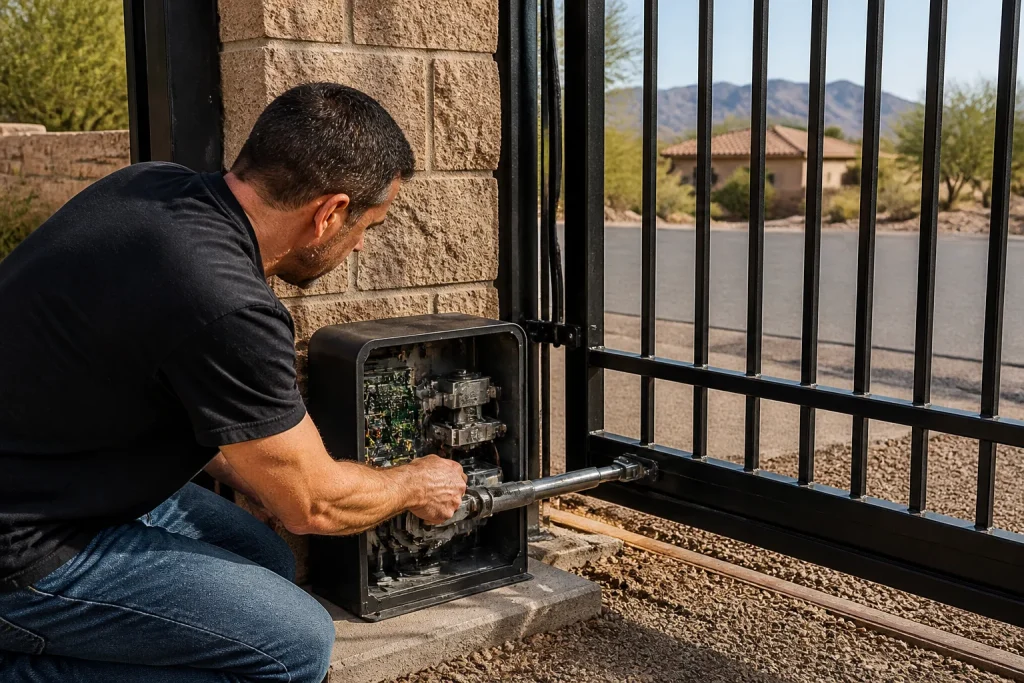
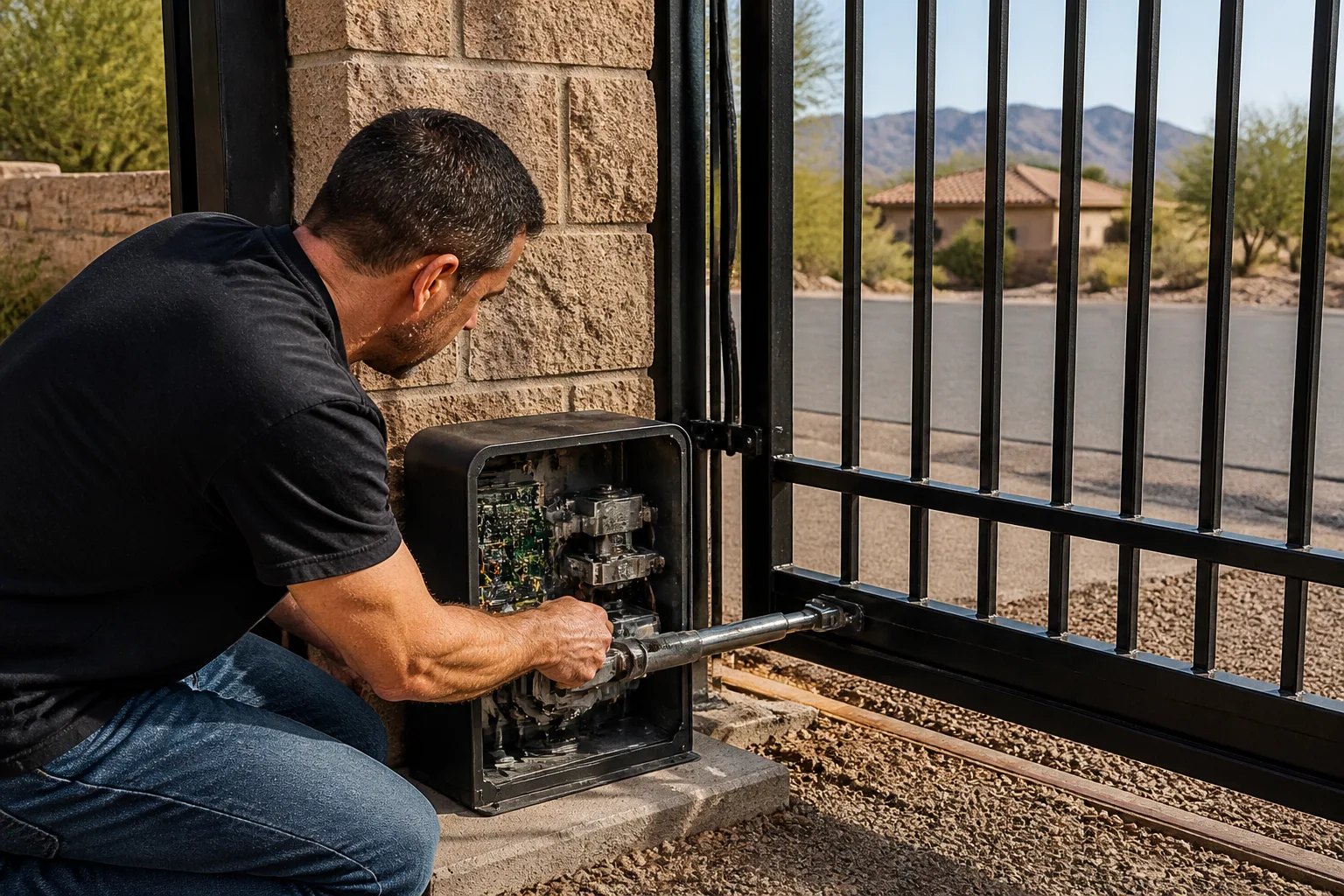
FAAC Gate Repair in Whitney: A Homeowner’s Guide
Most FAAC operators that “won’t open” still have a perfectly good motor. What has usually failed is the capacitor that starts it – a roughly $30 part that gets misdiagnosed as a $400 control board replacement when nobody checks the failure chain in order. FAAC units fail in a predictable sequence, and knowing that sequence lets you hand a technician real information before anyone drives out. This guide maps it, so you stop paying diagnostic labor to rediscover what the symptom already told you.
If you’d rather skip the troubleshooting and get a straight answer, call (844) 797-4861. A live person picks up, day or night, and estimates are free.
Key Takeaways
- FAAC operators fail in a set order: capacitor, then limit switch, then control board. Diagnosing out of order is how homeowners pay for parts they never needed.
- The onboard LED blink codes tell you which stage of the chain you’re in before a technician leaves the truck.
- Whitney’s alkaline dust is hard on FAAC encoder housings, especially on properties down near the valley floor.
- FAAC’s hydraulic models (B614, 391) fail differently than the electromechanical line, so repair-versus-replace math changes with the model.
- A proper written diagnostic report itemizes readings – voltage, capacitance, limit positions – not just conclusions.
Why do FAAC gates fail in a predictable order?
Because the parts wear at different rates under the same load. The capacitor works hardest and dies first. The limit switch takes mechanical abuse at every end of travel and goes second. The control board sits protected in the housing and is usually the last thing to fail – yet it’s the first thing many people replace. That’s the expensive mistake.
The chain looks like this:
- Capacitor. It gives the motor the jolt it needs to start turning. When it weakens, the gate may hum, stall, or start in one direction but not the other. Under load it gives up. This is the single most common FAAC starting failure, and it’s cheap.
- Limit switch. This tells the board where the gate is supposed to stop. When it drifts or fails, the gate over-travels, reverses randomly, or stops short. We’ve seen limit switches set 12 degrees past travel cause a gate to reverse mid-cycle every single time.
- Control board. The brain. It fails least often, but it does fail – usually from moisture, a surge, or a shorted accessory. It’s also the part that gets blamed first.
Skipping the order costs money. We’ve reviewed written estimates from other companies where a homeowner was quoted a full board replacement for what turned out to be a tired capacitor and a misaligned limit switch. If you have a FAAC unit in Whitney that’s acting up, the diagnosis should start at the front of the chain, not the back.
How do I read FAAC’s LED blink codes?
FAAC control boards report faults through a blinking LED. The number of blinks between pauses is a code, and the code narrows the problem before anyone touches a meter. You don’t need to reprogram anything – you just need to count.
On most FAAC boards, the sequence works like this: the LED flashes a set number of times, pauses, then repeats. That count points to a fault category – an obstacle detected, a limit-switch issue, a motor or capacitor fault, or a board-level error. The exact code meanings vary by board family, so the count is your starting clue, not your final answer.
What to do with it:
- Count the blinks carefully and write the number down. Include how many flashes before the pause.
- Note when it happens – on open, on close, at startup, or after a few cycles.
- Listen. A hum with no movement points one way; a clean motor sound with an early stop points another.
- Hand that note to your technician. A precise code saves diagnostic time, and on a documented job it goes straight into the written report.
In Whitney, we regularly see codes that read like a board fault but trace back to a limit switch knocked out of position by heat expansion at the end of travel. The blink code gets you to the right neighborhood; the meter gets you to the right house.
What happens to FAAC equipment in Whitney’s valley-floor dust?
Whitney sits close enough to the valley floor that alkaline dust finds its way into everything – and FAAC encoder housings are not immune. The encoder is the part that tells the board exactly where the gate is. When fine dust works into the housing, it can interfere with the encoder’s readings and produce symptoms that look electrical but are really environmental.
What we see on Whitney properties:
- Gates that behave perfectly in cool weather and act up in summer, because the dust and heat combine to throw off readings.
- Encoders that need cleaning and reseating rather than replacement – a difference of real money.
- Limit switches that drift as grit builds up at the end-of-travel contacts.
- Housings that were never sealed well from the start, letting dust in from day one.
The fix isn’t exotic. It’s routine cleaning, a proper seal, and an encoder check as part of the diagnostic. What matters is that the technician knows Whitney’s dust is part of the equation – not treating a dust problem as a dead board. When we service a FAAC unit in Whitney, the photo record we leave includes the condition of the encoder housing, so the next visit starts with information instead of a guess.
What should a written diagnostic report actually list?
Readings, not conclusions. A report that says “replaced control board” tells you nothing about whether that board was ever the problem. A report that lists the capacitance reading, the limit-switch position in degrees, and the voltage at the motor leads tells you exactly what was found and what was done – and it protects you if the gate fails again.
A proper FAAC diagnostic report should itemize:
- Capacitor reading. The measured capacitance against the rated value.
- Limit-switch positions. Where each limit was set at arrival and where it was reset to, noted in degrees or travel position.
- LED code observed. The blink count before any changes were made.
- Encoder condition. Clean, reseated, or replaced, with the reason.
- Board-level checks. Voltage at the motor leads and any accessory faults.
- Photos. Before and after of every adjustment and every part replaced.
Under our Haven Standard, every job ends with that photo record and a written price agreed before any work begins. You get the documentation whether you ask for it or not. That’s the record a future technician needs, and it’s the record that keeps you from paying twice to rediscover the same fault.
Do FAAC hydraulic models fail differently than the electromechanical line?
Yes, and the difference changes the repair-versus-replace math. FAAC’s hydraulic operators – the B614 and 391 among them – use a different drive system than the electromechanical units, and they fail for different reasons.
Hydraulic models (B614, 391): The failure points are seals, fluid condition, and the hydraulic circuit itself. A slow or sagging gate on a hydraulic unit often points to seal wear or fluid loss, not a capacitor. The motor may be perfectly healthy while the gate creeps or won’t hold position. Repair means identifying the seal or circuit issue – and if the housing has been compromised, that changes the decision.
Electromechanical models: These follow the capacitor-to-limit-to-board chain described above. The parts are cheaper, the failures are more common, and the fixes are usually straightforward.
What this means for you: a quote to replace a hydraulic FAAC operator should explain why the seals or fluid aren’t the fix. A quote to replace an electromechanical unit should show that the capacitor and limit switch were actually tested first. In Whitney, we’ve seen both mistakes – a hydraulic unit replaced when a seal kit would have done it, and an electromechanical unit scrapped when a $30 capacitor was the whole problem. We service FAAC alongside BFT and Viking units, so the recommendation follows what’s actually on the property, not what’s easiest to sell.
When to call a pro
Capacitors and control boards sit inside energized housings, and the gates themselves are heavy enough to cause serious injury if they move while you’re near the mechanism. Don’t open the control box or reach into the operator to test parts yourself. If your gate hums, reverses, stops short, or throws a blink code, that’s the point to call. We’ll read the code, meter the chain in order, and hand you a written price before anything gets replaced.
Related services in Whitney: For the full picture on fixing a gate that won’t open, see our Gate Repair in Whitney page. If your operator is at the end of its life and repair no longer makes sense, our Gate Motor & Opener in Whitney page covers replacements. And if you’re starting fresh with a new gate, Gate Installation in Whitney walks through what a new system includes. You can always start back at the Vance Gate Repair Whitney home page.
The Bottom Line
FAAC operators fail in order: capacitor, limit switch, control board. Diagnose in that order and you avoid paying for a board that was never the problem. Read the blink code, note when the fault happens, and hand that information to your technician. In Whitney, remember that valley-floor dust and heat are part of the equation, and that hydraulic models follow a different failure path than the electromechanical line. A written report should list readings and include photos – not just conclusions.
If you’re in Whitney and need help, Vance Gate Repair Whitney offers free estimates – call (844) 797-4861. A live person answers any hour, the price is written and handed to you before work starts, and every visit leaves a documented record of what was found and what was fixed.
Frequently Asked Questions
Most FAAC repairs in Whitney run between about $150 and $450 depending on what failed. A capacitor replacement sits at the low end; a limit switch or encoder service lands mid-range; a control board replacement is the high end. You get the exact flat price in writing before any work begins. Call (844) 797-4861 for an exact quote – estimates are free.
Often, yes. We keep same-day availability for repair calls in Whitney, and a live person answers the phone around the clock – no voicemail, no callback queue. The sooner you call with your blink code and symptoms, the faster we can confirm what’s likely wrong. Call (844) 797-4861.
Usually not. A hum with no movement is the classic signature of a failing capacitor – the motor is getting power but not the starting jolt it needs. A control board failure looks different. The blink code and a capacitance reading settle it in minutes rather than a parts swap. Call (844) 797-4861 to get it diagnosed in order.
It depends on what failed. Seal and fluid issues on a B614 or 391 are often repairable at a fraction of replacement cost, especially if the motor and housing are sound. A written diagnostic that shows the seal condition and circuit readings tells you which way the math goes. Call (844) 797-4861 for a free estimate and we’ll lay out both paths in writing.
Written by the team at Vance Gate Repair Whitney.
Need Gate Repair Help?
Call Vance Gate Repair Whitney - licensed & insured, here with fast after-hours help in Whitney.
(844) 797-4861