
Mighty Mule Gate Repair in Whitney: A Homeowner’s Guide
Mighty Mule builds gate openers that homeowners can install themselves, which is exactly why so many of them in Whitney get installed a little wrong. The manual includes a gate-weight-to-arm-length ratio chart, and in our experience about half of self-installers skip straight past it. Months later the gate drags, stalls halfway, or clicks and does nothing, and the call comes in as “my opener died.” Most of the time it didn’t die. It was set up wrong from day one.
This guide walks through what actually goes wrong, how to read your Mighty Mule’s LED codes so you’re not paying a technician to rediscover the obvious, and how to size a battery and solar kit for a Whitney summer. If you’d rather skip the diagnosis and get a written price, call (844) 797-4861.
Key Takeaways
- Self-install errors, not failed components, account for most Mighty Mule service calls in Whitney.
- Your opener’s LED blink pattern tells you which subsystem to look at before anyone touches the gate.
- The arm bracket angle and gate weight ratio are the two specs most often ignored, and both cause slow actuator wear.
- A proper service visit ends with a written record: stroke length, voltage under load, bracket angle.
What does the gate-weight-to-arm-length chart actually control?
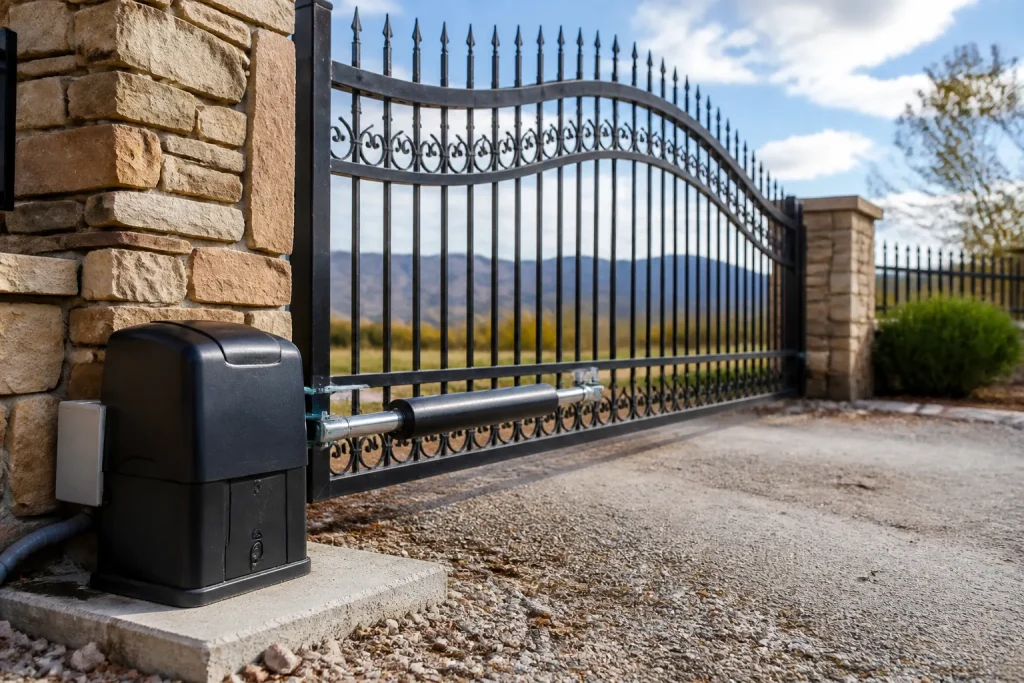
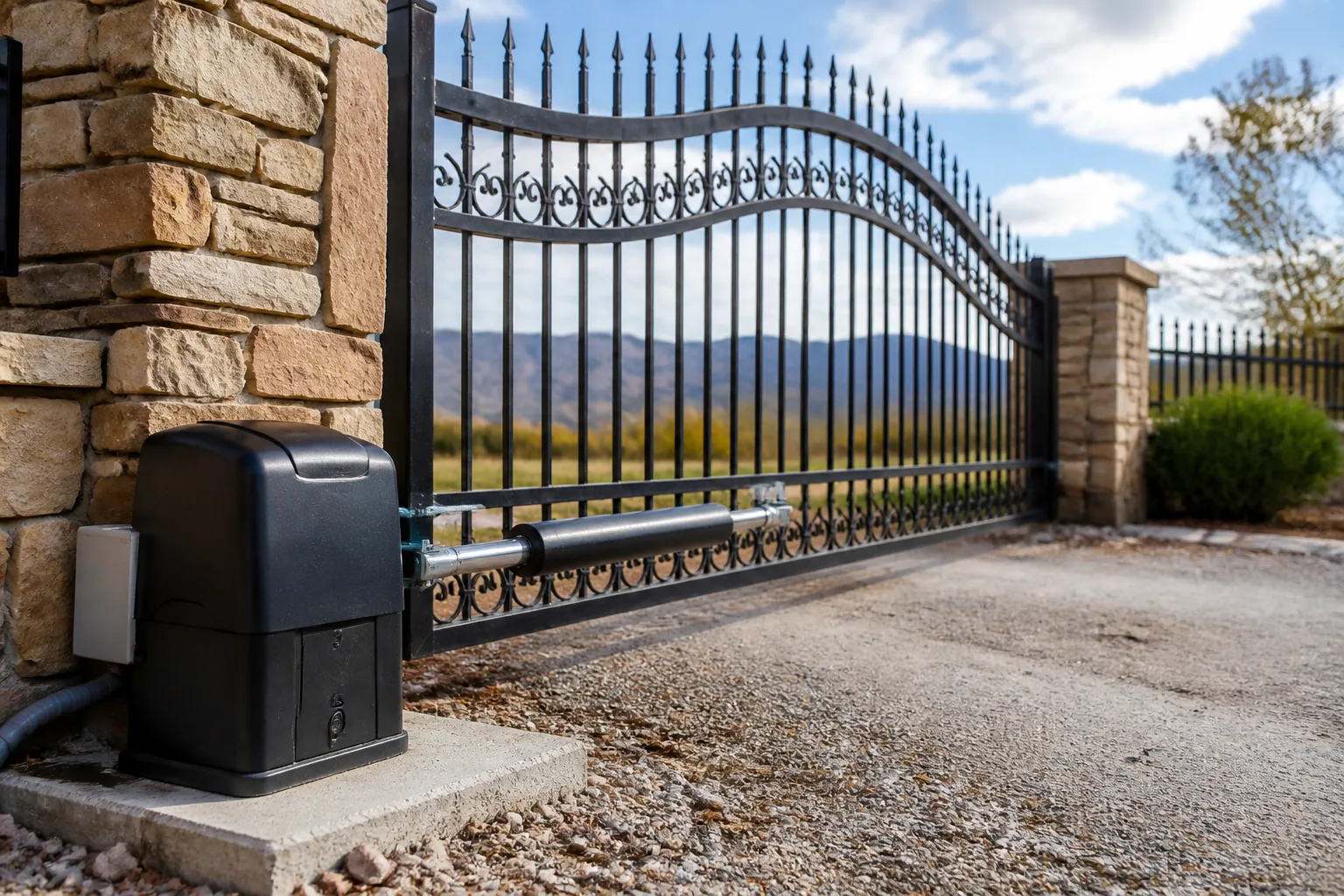
Mighty Mule’s manual publishes a ratio chart because a swing gate’s weight and its distance from the hinge determine how much torque the actuator has to produce to move it. Mount the arm too far out from the hinge and you’ve given the motor a longer lever to fight. Mount it too close and the arm bottoms out before the gate reaches full open. Either way the unit runs harder than it should, every single cycle.
The chart ties gate weight to a maximum arm extension. A 300-pound gate and a 150-pound gate do not get the same geometry, and a gate that’s heavier than your model’s rating gets no safe geometry at all. When we service a Mighty Mule in Whitney, the first thing we do is weigh the gate travel and measure the arm’s mounting point against the chart. Roughly half the time it’s off.
That matters because the symptom shows up late. The opener works fine for six or eight months, then the gate starts reversing at the halfway point, or the motor strains audibly on the last foot of travel. By then the actuator has been running hot for hundreds of cycles. If your gate is doing any of that, it’s worth having someone check the geometry before the motor quits entirely. Our Gate Motor & Opener in Whitney page covers what a proper diagnostic looks like.
The five self-install errors we find most in Whitney
These come up again and again. Each one installs quietly and presents as a failure much later, which is why homeowners assume the part died.
- Arm mounted outside the ratio chart. Presents as: gate reversing mid-travel, motor straining at the end of the swing, actuator housing warm to the touch after a few cycles.
- Bracket angle off from the manual’s spec. Presents as: premature actuator seal wear, a grinding or popping sound on open, and slop in the arm pin within a year.
- Limit switches never set. The opener pushes the gate into its physical stop every cycle. Presents as: the gate bouncing off the post, a hard jolt at full open, and eventually a stripped gear in the actuator.
- Battery and solar undersized for the cycle count. Presents as: the gate slowing noticeably in the afternoon, random “low battery” stops, and a unit that works fine on cool mornings and fails in August heat.
- Photo-eye or safety edge wired but not aligned. The infrared beam (the safety pair that stops and reverses the gate if something crosses its path) gets knocked out of line by a garbage can. Presents as: gate opens a foot and reverses, or refuses to close at all.
Number five is the one that generates the most panicked calls. It’s also the cheapest to fix once you know it’s the cause.
How do you read the Mighty Mule LED blink codes?
Mighty Mule control boards use a blinking LED to tell you which fault the board is seeing. The exact sequence depends on your model, so check the sticker inside the control box cover, but the principle is the same: count the blinks between pauses, then look that count up in your manual’s fault table.
What to write down before a technician arrives, so you’re not paying for discovery:
- The exact blink pattern (for example, three blinks, pause, three blinks) and how many times it repeats.
- Whether the gate fails on open, on close, or both.
- Whether the failure is consistent or only under certain conditions (afternoon heat, after a full day of cycles, only when the sun’s off the panel).
- Battery voltage if you own a multimeter, measured while the gate is mid-travel, not at rest.
- Whether the manual release disengages smoothly and the gate swings freely by hand.
That last one is a fast filter. If the gate won’t swing freely by hand with the opener disengaged, the problem is mechanical (hinges, sag, a bent arm) and no amount of board-level troubleshooting will fix it. If it swings easily, the fault is in the electronics or the safety circuit. A few notes on a sticky note save real time on the visit.
Battery and solar sizing for a Whitney summer
Mighty Mule’s default solar kit is sized on a conservative assumption: a modest number of cycles per day and a healthy number of peak sun hours. In Whitney, the sun-hours part usually holds up fine. What doesn’t hold up is the cycle count assumption on a busy household driveway, especially in July and August when the unit is cycling more and the battery is running hotter.
Here’s the practical math. A single-vehicle household running four to six cycles a day is comfortably within a stock Mighty Mule solar kit’s range. A household with two drivers, a gardener, and a delivery pattern that opens the gate a dozen times a day is not. In our experience, those gates need either a larger panel, a higher-capacity battery, or both. The symptom is subtle at first: the gate moves a little slower in late afternoon, then one hot day it just stops mid-swing and won’t re-engage until the battery recovers overnight.
Heat matters here too. A battery mounted in direct sun on a Whitney gate post in August runs warmer than the same battery in a shaded enclosure, and heat shortens service life. If your Mighty Mule consistently misbehaves only in summer, suspect the battery and its enclosure before you replace the control board. If you’re weighing whether to repair or replace a tired unit, a free second opinion on any written estimate is worth having before you commit. The Gate Repair in Whitney page covers the repair side in more detail.
Measuring your arm bracket against Mighty Mule’s tolerance
Mighty Mule specifies a mounting angle for the actuator arm bracket relative to the gate and post. Get outside that tolerance and the arm’s pivot points wear faster, because the actuator is pulling at an angle it wasn’t designed for. The good news is you can check it yourself with a level and a tape measure before anything fails.
With the gate in the closed position and the opener engaged, check three things against your model’s chart: the height of the bracket above the gate’s centerline, the distance from the hinge to the bracket, and whether the arm sits roughly level at mid-travel. If the arm visibly rises or drops as the gate opens, the bracket is off. If you can see slop in the pin where the arm meets the bracket, it’s been off for a while.
That slop is the early warning. It doesn’t fail the opener immediately. It chews the seal at the actuator rod, lets a little moisture in, and one day the motor runs but the gate doesn’t move. When we correct a bracket angle in Whitney, we photograph the new position and note the measurement, so the next visit has a reference point. If your bracket needs re-mounting or the gate hardware needs welding, Gate Installation in Whitney covers the structural side of that work.
What a proper Mighty Mule service close-out should include
Most gate repairs are invisible once the technician drives away. Six months later, a different company shows up with no idea what was adjusted or why. That’s how homeowners end up paying twice to rediscover the same problem. Here’s what the record should contain, and what we hand over before we leave any job.
- Actuator stroke length: the measured travel of the arm, matched to the gate’s swing, so the limit settings can be verified against a number instead of a guess.
- Battery voltage under load: measured mid-cycle, not at rest, because a resting voltage tells you almost nothing about capacity.
- Bracket angle and mounting measurement: the number, photographed, so if the arm drifts the next technician knows the original baseline.
- Limit switch positions: noted and photographed on both the open and close sides.
- Parts installed: the actual part number, not a description.
This is the core of The Haven Standard: a written price before work starts, a documented photo record on every visit, and the 365-Day Done Right Promise covering completed work for a full year. If a repair doesn’t hold, we make it right within that window. The same discipline applies across other brands, from DoorKing to Elite to LiftMaster, because good documentation isn’t brand-specific.
The Bottom Line
Mighty Mule’s DIY-friendly design is a real advantage for a homeowner who reads the manual carefully. The catch is that the specs most often skipped (the weight ratio, the bracket angle, the limit switches, the battery sizing) are exactly the ones that cause failures months later, disguised as dead components. Before you replace a control board, check the geometry and the LED sequence. A written record of the last visit’s settings makes every future repair faster and cheaper.
If you’re in Whitney and would rather have someone measure the install and read the codes, Vance Gate Repair Whitney offers free estimates. Call (844) 797-4861 and a live person answers, any hour. You’ll get a flat written price before work starts, and a documented photo record when the technician leaves.
Frequently Asked Questions
In our experience the most common cause is a self-install error that finally wore through a component: a limit switch never set, an arm bracket outside tolerance, or an undersized battery failing under load. The opener usually didn’t fail on its own. It was set up wrong months earlier, and the symptom just arrived. Call (844) 797-4861 for a look before replacing the unit.
You can check the LED blink pattern, measure your bracket angle, and test whether the gate swings freely by hand. Those three checks tell you a lot. For anything involving the control board, rewiring, or replacing the actuator, call a technician. Gate actuators carry real force, and a gate that runs when it shouldn’t is a genuine hazard. Call (844) 797-4861 for a free estimate.
It depends on the fault, but the written price comes before any work starts, always. A limit switch adjustment or bracket re-mount is a quick job. An actuator replacement costs more. You’ll see the number in writing before we pick up a tool, and it won’t change at invoicing. Call (844) 797-4861 for an exact quote, and estimates are free.
Yes. We service nine major gate automation brands, including LiftMaster, FAAC, BFT, Linear, Viking, Ghost Controls, DoorKing, Elite, and Mighty Mule. We’ll work on whatever motor is already on your gate rather than steering you toward a replacement. For a free estimate on your specific unit, call (844) 797-4861 or see our Vance Gate Repair Whitney home page.
Written by the team at Vance Gate Repair Whitney.
Need Gate Repair Help?
Call Vance Gate Repair Whitney - licensed & insured, here with fast after-hours help in Whitney.
(844) 797-4861