
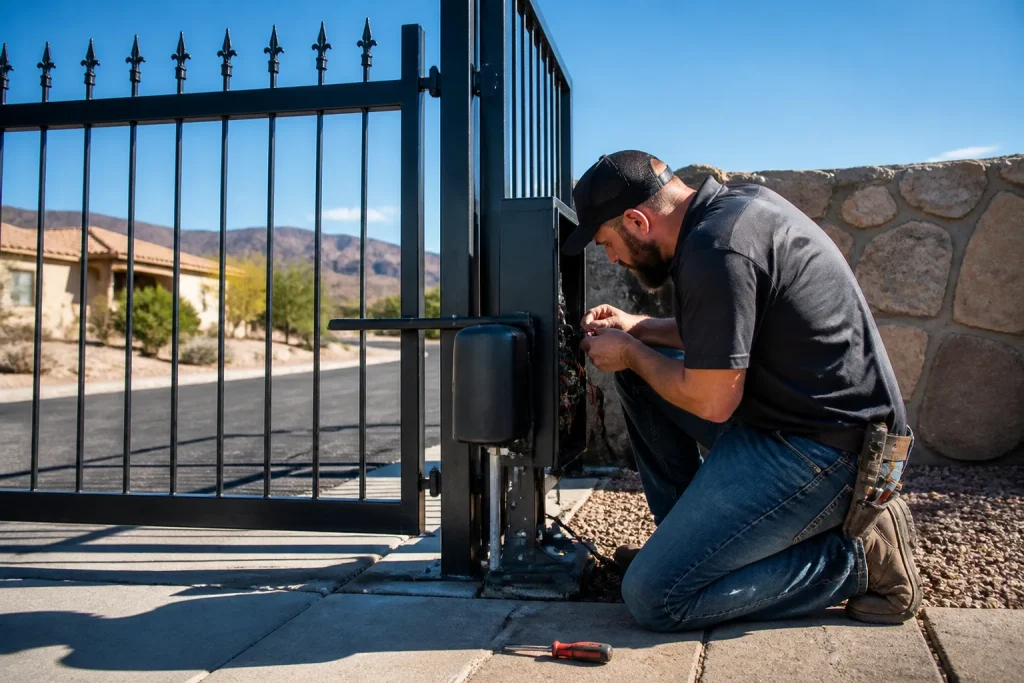
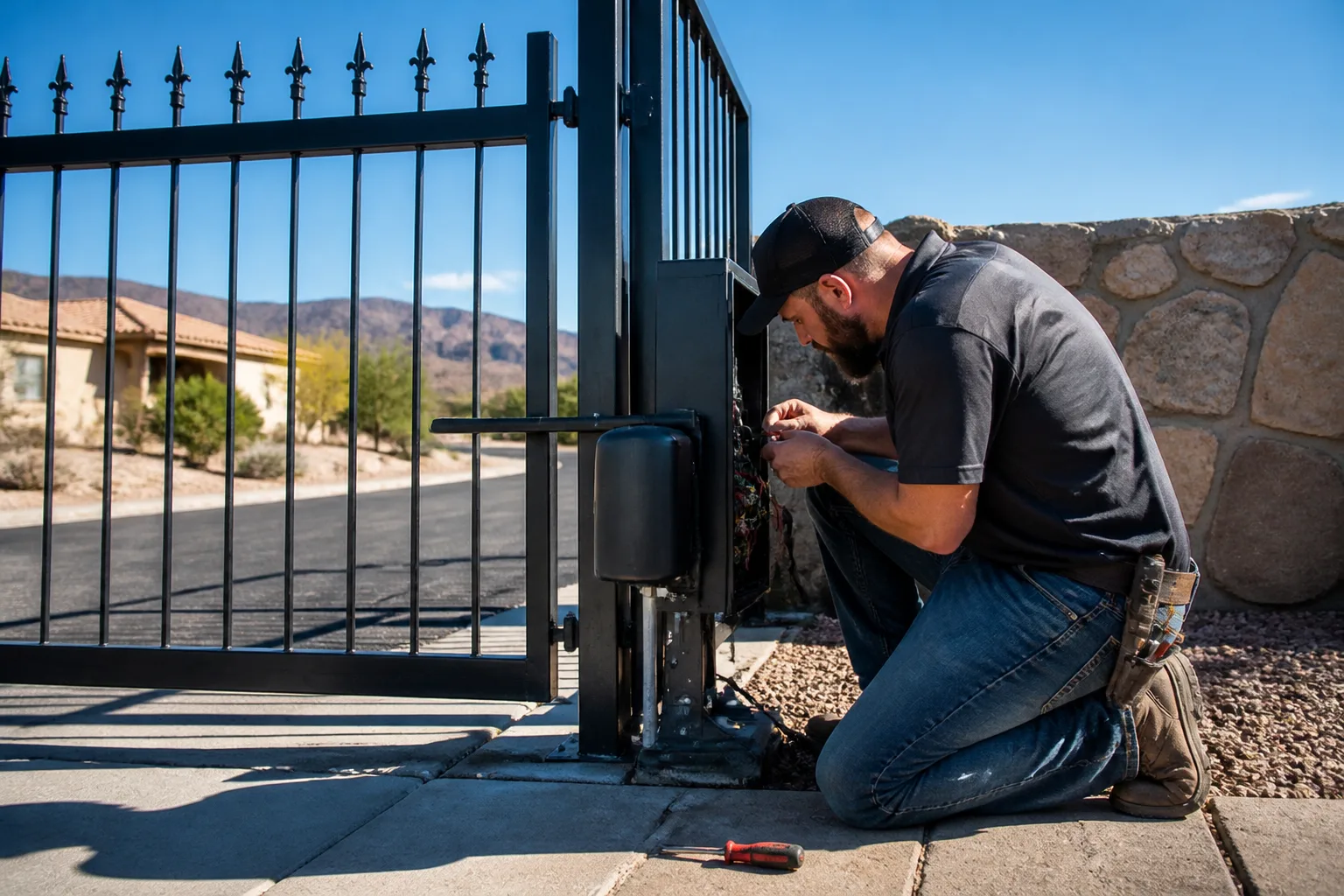
BFT Gate Repair in Whitney: A Homeowner’s Guide
BFT’s obstacle-detection system is sensitive enough to stop a gate for a moth. That’s a safety feature, right up until an undertrained technician reads repeated safety stops as a dying control board and quotes you $600 to replace something that needed a 90-second parameter adjustment. We’ve watched that exact invoice play out more than once around Whitney, and it’s the single most common BFT misdiagnosis we get called out to correct. If you’d rather skip the guesswork, call (844) 797-4861 and we’ll tell you what we actually found.
Why BFT Operators Get Misdiagnosed in Whitney
BFT makes serious commercial hardware, and its residential line is built to the same logic. The problem is market coverage. In Whitney, most gate technicians cut their teeth on Linear and Viking swing operators, and those systems are forgiving in ways BFT isn’t. A Linear arm that binds will usually grunt and keep going. A BFT DEIMOS will read that same bind as an obstacle and reverse, then reverse again, then lock out after repeated safety trips.
To someone who doesn’t know the platform, a gate that reverses three times and stops looks like a failed controller. To us, it looks like a force parameter set too tight for a hinge that’s picked up grit or a gate leaf that’s dropped a quarter inch on its post. Same symptom, completely different invoice.
Here’s what the two diagnoses actually cost to resolve:
- Force-sensitivity reset and travel re-teach: a straightforward adjustment, priced as a service call rather than a parts job.
- Hinge and post correction before re-teaching: more labor, but still no board.
- Control board replacement: the expensive path, and the one that’s quoted far more often than it’s needed.
The tell is almost always in the documentation. A BFT that stopped because of an obstacle event will have logged it. A BFT with a genuinely failed board usually won’t. Reading that difference takes ten minutes with a meter and a parameter printout. Guessing at it takes a customer’s money. For the broader repair picture in Whitney, our Gate Repair in Whitney page covers what a standard visit looks like.
How BFT’s Force and Obstacle Sensitivity Parameters Drift
BFT operators use a force-sensitivity setting to decide how much resistance the gate has to meet before the controller treats it as an obstruction. That setting is factory-tuned to a gate that moves freely. When the gate stops moving freely, the operator doesn’t know the gate changed; it only knows it’s meeting resistance, and it reacts the way it was designed to.
The drift usually comes from three places:
- Hinge wear. A hinge that’s lost grease adds drag, especially on the latch side of a swing gate. The force reading climbs, the operator trips earlier, and the homeowner notices the gate “stopping for no reason.”
- Post settlement. Whitney’s soil moves with moisture, and a gate post that’s shifted even slightly changes the geometry the operator has to push through. We’ve reset travel on gates in Whitney where the only real problem was a post that had crept an eighth of an inch.
- Temperature-driven mechanical drag. Metal contracts on cold nights. A gate that swings clean at 2 p.m. can bind slightly at 6 a.m. in January, which is why the fault seems intermittent.
Recognizing a sensitivity fault versus a motor fault comes down to behavior. A sensitivity fault is repeatable and positional: the gate fails at the same point in travel every time. A motor fault is usually load-dependent and vaguer: the operator struggles everywhere, or hums without moving, or trips a thermal cutout under any real load. If your gate fails at the same spot on the driveway every single cycle, you’re probably looking at sensitivity, not a dead motor.
DEIMOS vs. VIRGO: Why the Repair Approach Differs
BFT’s DEIMOS and VIRGO operators share a brand but not a repair path, and treating them the same is how technicians get into trouble. The DEIMOS line is the heavier swing operator; the VIRGO sits at the more compact end of the range. The control logic is related, but the mechanical access, the encoder arrangement, and the way each unit self-learns its travel are different enough that a procedure that works on one can send the other into a fault loop.
In practice, that means:
- Access differs. Getting to the board and encoder on a DEIMOS install is a different job than on a VIRGO, and the physical clearances change how you read the encoder during a test cycle.
- Self-learning behaves differently. Each operator runs a learn cycle to map its open and close limits. The parameters it writes and how it reports a failed learn aren’t identical between the two families.
- Force defaults aren’t interchangeable. A setting pulled from a DEIMOS manual and applied to a VIRGO is a guess, not a specification. We’ve corrected installs in Whitney where exactly that had happened, and the gate had been tripping on its own weight for months.
This is part of why we service nine major automation brands rather than steering every customer toward a replacement. If your gate already has a BFT on it, the right move is usually to repair the BFT. Our Gate Motor & Opener in Whitney page goes deeper on operator service if you’re weighing repair against replacement.
What “Self-Learning Failure” Actually Tells You
When a BFT operator throws a self-learning failure, it’s telling you it couldn’t complete its travel-mapping cycle. It is not, despite what some quotes suggest, automatically telling you the board is dead. The learn cycle fails for a short list of reasons, and most of them are mechanical.
The common causes, roughly in order of how often we find them:
- The gate can’t complete full travel. Something is stopping it short: a bind, a worn hinge, a physical obstruction, or a limit that’s set past the gate’s actual range.
- The encoder isn’t reporting cleanly. A dirty or misaligned encoder gives the controller bad position data, and the learn cycle can’t reconcile it.
- The force threshold is too tight for the gate’s real drag. The operator tries to learn travel, meets resistance it’s been told to treat as an obstacle, and aborts.
- Genuine controller fault. This is real, and it happens, but it’s last on the list for a reason. We confirm it with readings, not with a hunch.
A proper diagnosis walks that list in order and documents each step. If a technician jumps straight to “the board’s gone,” ask what the force readings were at open and close. If there’s no answer, there’s no diagnosis.
Whitney’s Temperature Swings and BFT Thermal Cutouts
Whitney runs hot afternoons and cold nights, and that daily swing does real work on a gate operator. BFT units include thermal protection that temporarily shuts the motor down when it’s been working hard in heat. That’s normal and by design. It becomes a diagnostic problem when a gate that’s genuinely binding gets pushed through repeated cycles on a 105-degree afternoon, trips thermal, and gets reported as “the motor keeps dying.”
What we check before anyone calls it a motor failure:
- Whether the fault is time-of-day dependent. A cutout that only happens mid-afternoon in summer is thermal behavior, not a failed motor.
- Whether the operator is in direct sun. A housing that bakes all day runs hotter and cuts out sooner than one in shade, and a housing that’s been repainted a dark color makes it worse.
- Whether the mechanical drag climbed. Cold-night contraction plus warm-day expansion changes the force the gate presents, and a marginal setup will trip on the hot end of the range even when it’s fine at 7 a.m.
The fix for most of these isn’t a part. It’s correcting the drag, re-teaching travel, and setting force to a value that holds across the whole temperature range rather than the one pleasant hour when the technician happened to be on site. If you’re in Whitney and your BFT quits every afternoon around 3, that’s the first thing to look at.
What a Proper BFT Repair Record Should Document
This is where most BFT repairs fall apart six months later, when a different technician shows up, sees a complicated controller, and starts guessing again. A repair record worth keeping has four things in it, and you should be handed all four before anyone leaves your driveway:
- A parameter printout. The actual settings the operator is running, before and after the adjustment. Not a summary. The values.
- Force readings at open and close. Measured, written down, and ideally photographed on the display if the unit shows them.
- Photos of the encoder and the board. So the next person can see condition and wiring without taking anything apart blind.
- The part number of anything replaced. Written, not verbal.
We run every job under The Haven Standard, which means the written price is in your hands before a tool comes out, and you get a documented photo record when the technician leaves. That second part matters more on BFT than on almost any other platform, because the next person to open that housing shouldn’t have to rediscover what the last one already knew. If you’ve got a written estimate from another company for a BFT board replacement, bring it over. We’ll review it at no cost and tell you whether the diagnosis holds up.
When to call a pro: BFT controllers sit at line voltage, and the capacitor on a gate operator can hold a charge after the breaker is off. This isn’t a platform to learn on. If you’re seeing repeated safety reversals, a learn cycle that won’t complete, or a thermal cutout that’s become routine, that’s the point to stop cycling the gate and get it looked at.
Related services in Whitney: Gate Installation in Whitney if the operator is beyond economical repair, and our Vance Gate Repair Whitney home page for everything else.
The Bottom Line
Most BFT “board failures” in Whitney are force-sensitivity and travel problems wearing a controller costume. A DEIMOS and a VIRGO need different handling, a self-learning failure is a symptom rather than a verdict, and Whitney’s temperature swings make thermal cutouts look like motor failures more often than they are. The difference between a correct repair and an expensive wrong one is usually documentation: parameter values, force readings, and photos of the encoder and board, kept and handed over. Our technicians have up to 12 years of experience across nine major automation brands, BFT included, and every visit ends with a written record of what was found and what was set.
If you’re in Whitney and need help, Vance Gate Repair Whitney offers free estimates. Call (844) 797-4861 and a live person will answer, any hour.
Frequently Asked Questions
Most BFT repairs in Whitney fall into service-call pricing for force resets, travel re-teaching, and encoder correction, with board replacement at the high end. We write the price and hand it to you before any work starts, so there’s no invoice surprise at the end. Call (844) 797-4861 for an exact quote on your operator; estimates are free.
Usually not. Repeated reversals are BFT’s obstacle detection doing its job, triggered by hinge drag, post movement, or a force setting that’s too tight. A board failure is possible but it’s the last thing to check, not the first. Call (844) 797-4861 and we’ll read the force values before anyone quotes a controller.
It means the operator couldn’t complete its travel-mapping cycle, and the usual cause is mechanical: a bind, an obstruction, a limit set past the gate’s range, or an encoder reporting dirty. It does not automatically mean the board has failed. Call (844) 797-4861 for a diagnosis that documents the readings, not a guess.
Yes. We service BFT alongside Linear, Viking, Ghost Controls, and several other automation brands, and we repair the operator that’s already on your property rather than steering you toward a replacement. Call (844) 797-4861 to schedule a visit in Whitney.
Written by the team at Vance Gate Repair Whitney.
Need Gate Repair Help?
Call Vance Gate Repair Whitney - licensed & insured, here with fast after-hours help in Whitney.
(844) 797-4861